The other day, I was watching a video explaining what happens to roll center when you lower a car, and something caught my attention.
The basic argument is, “People say lowering the car messes up the roll center and all that, but in reality, you’re also running stiffer springs, so you don’t really need to worry about it!”
And I completely agree with that.
You don’t see any truly fast drivers saying, “I won’t lower my car because it messes up the roll center.”
So everyone, feel free to lower your cars all the way to the ground!
Anyway, there was one part of the explanation that caught my attention.
“Running stiffer springs when you lower the car actually makes a lot of sense. The tires are pressed against the road by the force generated by the springs, and the greater that force is, the more grip the tires have. To generate a greater spring force, you want to be able to compress a stiff spring further, and this is where the roll center becomes important. Compared with running stiff springs at the stock ride height, running stiff springs with a lowered ride height allows you to generate more spring force because of the effect of the roll center.”
So what exactly does that mean?
Take a look at the illustration below.
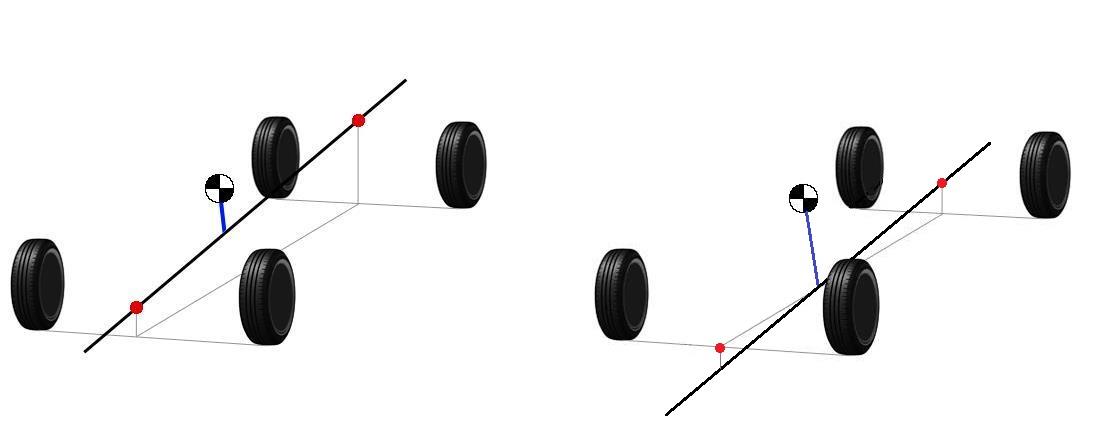
These are two cars with the same center of gravity height but different roll axis heights.
As you can see, the roll axis is higher in the illustration on the left and lower in the one on the right.
The distance from the center of gravity to the roll axis is called the roll arm length.
The longer the roll arm, the greater the moment trying to roll the car when it is subjected to the same amount of lateral G.
In the illustration on the right, the center of gravity height and the roll arm length are roughly the same.
Now, when you lower the roll axis as shown in the illustration on the right, the roll arm becomes longer, so the amount of body roll increases under the same lateral G.
Compared with running stiff springs with a high roll axis, running stiff springs with a lower roll axis and therefore more body roll causes the springs to compress further.
And the more the springs compress, the greater the spring force becomes.
So the load on the tires increases, and the tires gain more grip.
That seems to be the logic behind the explanation in the video.
But I don’t think that’s right.
Even if the load on the outside tire were to increase, the load on the inside tire would decrease by the same amount, so the total grip of the two tires would not simply increase.
But even before we get to that, there’s a more fundamental problem: increasing the roll arm length does not increase the load on the outside tire in the first place…
It is true that a longer roll arm means that the stiff spring compresses further.
But that doesn’t mean the load on the outside tire increases.
The key to understanding this is the anti-roll effect generated by the suspension arm geometry.
The anti-roll effect I’m talking about here is not the effect of an anti-roll bar. It is generated by the angle of the suspension arms.
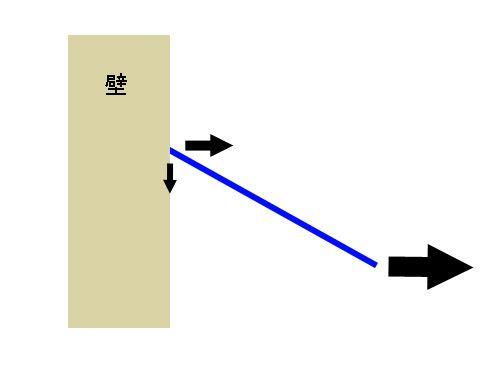
The principle is actually quite simple.
Imagine pulling a rod that is mounted diagonally against a wall in a direction parallel to the ground. The force generated is not only parallel to the ground; it also has a downward component.
If you push the rod into the wall instead, the vertical component acts in the opposite direction, producing the same kind of effect.
Anti-dive, anti-lift, anti-squat, jacking up, and jacking down are all based on the same principle.
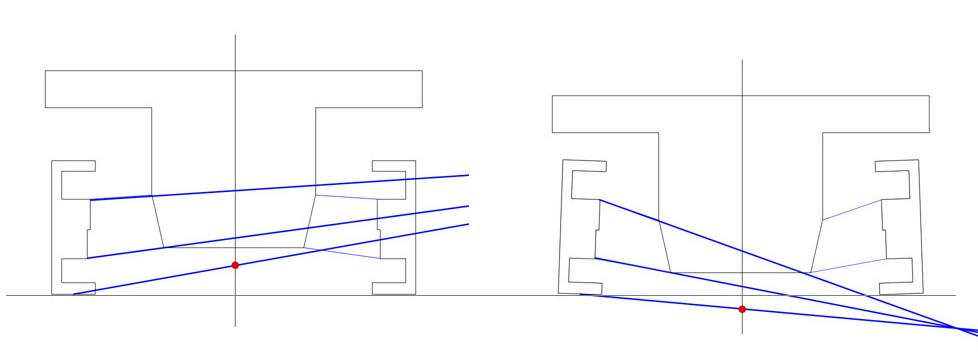
Now let’s look at the previous illustration from the front.
The roll centers are different at the front and rear, but to make the mechanism easier to explain, I’ll use the front roll center here.
When you raise the roll center, the suspension arm angles downward from the chassis toward the tire. More precisely, on a double-wishbone suspension, this refers to the angle of the line connecting the point where the extended upper and lower arm lines intersect and the center of the tire contact patch.
When the arm receives input from the tire, this geometry generates an anti-roll effect: the inside of the body moves downward and the outside moves upward, meaning the body tilts in the opposite direction from body roll.
Lowering the roll center produces the opposite effect.
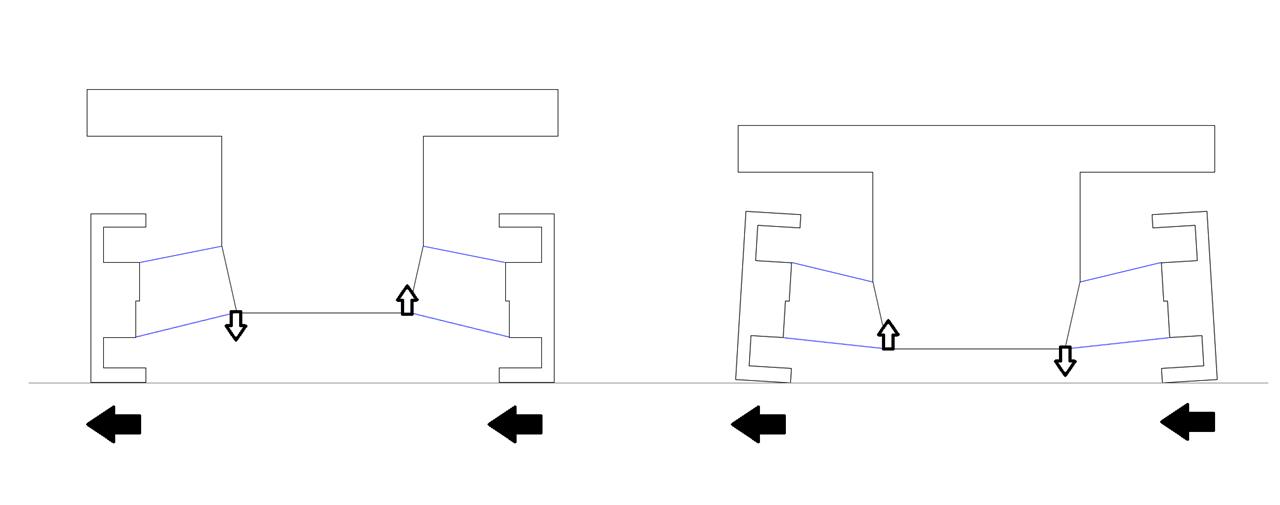
As the name suggests, this anti-roll effect acts as a moment—a rotational force—in the opposite direction to body roll.
The source of this force is the tire’s cornering force.
However, the force is transmitted through the tire → suspension arm → body, so it does not pass through the spring.
It is purely a matter of the suspension arm geometry.
In other words, when the roll center is high, this anti-roll effect takes on part of the roll moment generated by load transfer.
When the roll angle is constant, such as during a steady-state corner, the moment trying to roll the car and the moments pushing it back are in equilibrium.
When the roll axis is high and the anti-roll effect is present, the moment balance is:
“Roll moment generated by load transfer” = “Moment opposing roll generated by roll stiffness” + “Moment opposing roll generated by the anti-roll effect”
Load transfer generates a moment that tries to roll the car, while the roll stiffness provided by the springs and anti-roll bars, together with the anti-roll effect, pushes back against it.
This represents a state in which all of these moments are in equilibrium.
In other words, when the anti-roll effect is present, the roll stiffness does not have to handle all of the roll moment by itself.
By contrast, when the center of gravity height and roll arm length are equal and there is no anti-roll effect, the moment balance is:
“Roll moment generated by load transfer” = “Moment opposing roll generated by roll stiffness”
Because there is no anti-roll effect, the entire moment generated by load transfer has to be handled by the roll stiffness.
Anti-roll was helping out before, but now it’s gone, so the roll stiffness has to do all the work by itself.
That’s a lot of work for the roll stiffness.
So it compresses more than it would when the anti-roll effect is present.
The spring does compress more, but ultimately, the load on the tire is determined by the initial load and the amount of load transfer, so it doesn’t matter whether the roll moment is large or small.
When you see the spring compressing a lot, it may seem like the resulting spring force must mean that a greater load is being applied to the tire.
But even when the spring compresses less, the reaction force from the anti-roll effect is also applied to the tire, so the total is the same in the end.
Incidentally, if you lower the roll axis deep into the ground, the moment balance becomes:
“Roll moment generated by load transfer” + “Roll moment generated by the roll-increasing effect” = “Moment opposing roll generated by roll stiffness”
In this case, the car rolls even more than before.
But the roll-increasing effect generated by the cornering force is simply increasing the roll angle. The reaction force from the additional spring compression caused by that roll is balanced by the roll moment generated by the cornering force × roll arm length.
The load on the tire itself remains unchanged.
So, lowering the roll center does not increase tire grip by increasing spring force.
Therefore, you don’t need to lower the car because “lowering the roll center gives you more grip.”
That said, lowering the car can lead to problems such as the damper bottoming out, arm lock (the suspension arm hitting the body), and tire contact with the body at full compression.
For that reason, the usual approach is to lower the car as far as you can go, while staying within those physical limits.
If you want to get into the details, there is also the issue of the range of alignment change. However, in motorsports, when lowering the car causes problems with dynamic alignment, it is common to address the issue not by raising the car back up, but by fitting stiffer springs so that the suspension simply doesn’t move in the first place.
The S2000 is a good example. You make the springs extremely stiff so the suspension barely moves.
Then the suspension starts to bounce and you run into traction problems, so you compensate for that with a mechanical LSD with strong locking characteristics.
And yet, this kind of reactive approach can still work in practice, which shows just how significant the benefits of lowering a car can be.
Lowering a car really is something, isn’t it?