Do you guys drive on circuits, compete in gymkhana, or go on mountain road attacks?
When you think, “I want to go even one second faster!”, you might start adjusting your coilovers to tune steering characteristics such as understeer and oversteer.
You’ve probably heard things like making the front springs stiffer will cause understeer, or raising the rear ride height will make the car oversteer.
However, you don’t often see the specific mechanisms behind these effects explained in magazines or on the internet, so this kind of knowledge isn’t particularly widespread.
Knowing the mechanisms doesn’t mean you can immediately find a fast setup, but if you understand the fundamentals, you start to see things like, “This is what I need to solve the problem I’m having right now,” or “This probably won’t make much difference.”
You’ll also be less likely to find yourself wondering, “How can I fix this problem with my suspension?” or getting confused by all the questionable theories floating around out there.
So, this time, I’d like to put together an article about tuning steering characteristics from the perspective of the physical properties of tires.
【Key Points】
(1) Tuning steering characteristics means adjusting the front-to-rear balance of cornering force
(2) It is important to consider the total cornering force from the left and right tires
(3) The greater the load transfer, the lower the total cornering stiffness of the left and right tires
(4) The two major factors that determine the front-to-rear distribution of load transfer are roll stiffness and link angle
(5) The height of the roll center changes the relative influence of each factor
Steering Balance Starts with the Tires
So, first, let’s look at (1), “Tuning steering characteristics means adjusting the front-to-rear balance of cornering force.”
This is, well, pretty much exactly what it says.
If the front tires have a greater cornering force relative to the rear, the car will turn more easily. If the rear tires have a greater cornering force, the car will be more stable.
However, suspension is often discussed using phrases like, “The front rolls easily, so the car understeers,” or “The rear is too stiff, so the car oversteers.”
If you only think about it in those terms, it’s hard to understand what ultimately happens and how that leads to a change in characteristics such as understeer or oversteer.
A car is connected to the ground only through its four tires, so changes in attitude such as body roll and pitching motion are ultimately just part of the process of transmitting forces. It is the front-to-rear balance of cornering force that directly affects understeer and oversteer.
Whether we’re talking about springs, anti-roll bars, or damping force, it is important to keep asking yourself, “How does this ultimately affect the front-to-rear balance of cornering force?”
Next, let’s look at (2), “It is important to consider the total cornering force from the left and right tires.”
In general, I think the better someone is at driving, the more smoothly they tend to manage load transfer. But as you can see from expressions like “put more load on the tire” or “really load up the tire,” when load transfer is discussed as a driving technique, people basically only think about the tire that gains load—the outside tire.
That’s fine if we’re only talking about driving technique, but the tire on the side that loses load, in other words, the inside tire, isn’t doing absolutely nothing either (except in cases such as when the inside rear tire of an FF car lifts off the ground).
There are two front tires, and there are two rear tires.
So, when talking about steering characteristics such as understeer and oversteer, it is important to consider the total cornering force from the left and right tires.
Why Load Transfer Reduces Total Cornering Stiffness
Next, let’s look at (3), “The greater the load transfer, the lower the total cornering stiffness of the left and right tires.”
First, take a look at this graph.
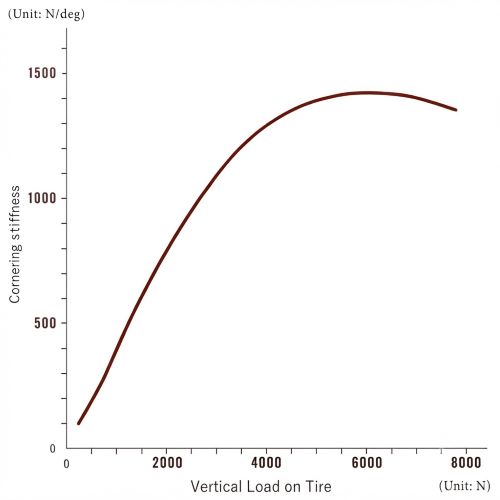
This graph was drawn with reference to Fig. 10 of “Flat-Belt Suspension Tire Test Machine” (Tomoki Sakai, Kaoru Kusaka, and Yuji Sato), published on the Honda R&D technical paper site, and was made to closely match the original.
The vertical axis of the graph is cornering stiffness (cornering force per unit slip angle), and the horizontal axis is load.
As you can see, the way cornering stiffness increases as the load on a tire increases is not directly proportional.
Cornering stiffness increases as the load increases, but the greater the load becomes, the less it increases.
After a certain point, it actually starts to decrease.
This is called tire load sensitivity.
Now, let’s say we have a car where the load on each front tire at 1 g is 4,000 N.
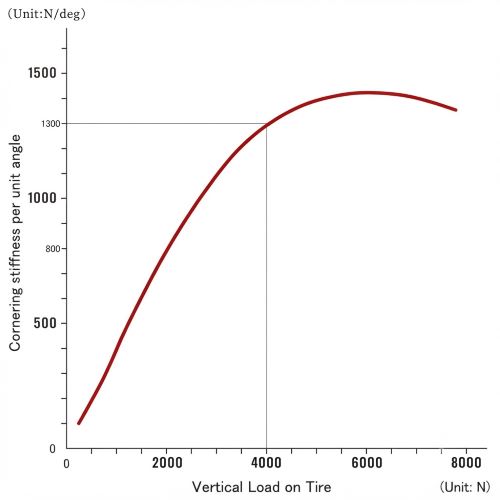
When this car corners, load transfer reduces the load on the inside tire and increases the load on the outside tire.
For example, if 2,000 N of load transfer occurs, the inside tire load becomes 2,000 N, while the outside tire load becomes 6,000 N.
The graph would then look like this.
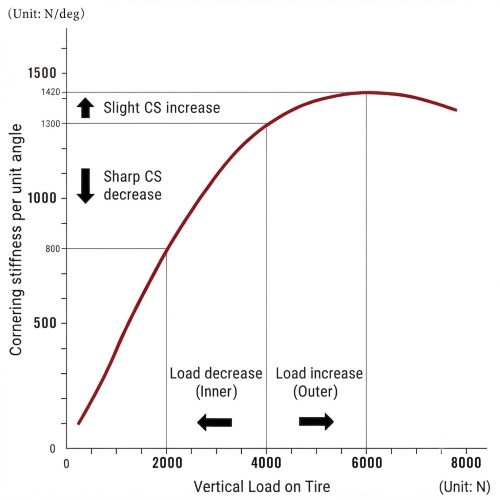
Now, pay attention to how the cornering stiffness of the inside and outside tires changes.
The cornering stiffness of the outside tire has increased.
It has increased, but not by very much.
Meanwhile, the cornering stiffness of the inside tire has decreased a lot.
Now, let’s calculate the total for the inside and outside tires.
Before load transfer
Inside tire 1,300 N/deg + Outside tire 1,300 N/deg = Total 2,600 N/deg
After load transfer
Inside tire 800 N/deg + Outside tire 1,420 N/deg = Total 2,220 N/deg
The total cornering stiffness has decreased because of load transfer.
This characteristic of tires is one of the most fundamental things to understand when thinking about steering characteristics.
Whether changing the springs changes the steering characteristics, or changing the front-to-rear ride height balance changes the steering characteristics, both are ultimately caused by this characteristic of tires.
This is also one of the reasons why sports cars have a low center of gravity.
If a car has a high center of gravity, it will experience more load transfer under the same lateral acceleration. That reduces the total cornering force, making it harder to drive fast, so the center of gravity is lowered to gain as much grip as possible and improve the car’s performance.
Now that we’ve confirmed this characteristic of tires, let’s finally move on to suspension tuning.
What Determines the Front-to-Rear Distribution of Load Transfer?
First, let’s look at (4), “The two major factors that determine the front-to-rear distribution of load transfer.”
【Things related to roll stiffness】 (Examples)
・Coil springs
・Anti-roll bars
・The amount of compression of the bump stops
etc.
【Things related to link angle】 (Examples)
・Ride height
・Roll center adjusters
・Damper damping
etc.
For example, if you make the front coil springs stiffer and the rear softer, the front will take a greater share of the load transfer when the car undergoes body roll.
As we saw earlier, tires have load sensitivity, so if the front takes a greater share of the load transfer, the total cornering force from the left and right front tires decreases, making the car harder to turn.
However, those aren’t the only factors that determine the front-to-rear distribution of load transfer.
The front-to-rear distribution of load transfer also changes depending on the angle of the suspension links (or suspension arms).
For example, if the links are initially parallel to the ground and you raise the ride height, the links will angle downward toward the outside of the car. If you raise the front ride height only while leaving the rear parallel to the ground, the angle of the front suspension links during body roll will cause a greater proportion of the load transfer to be transmitted through the links at the front.
Be careful here, though. The front-to-rear difference in the amount of load transfer that occurs is simply a difference in the front-to-rear distribution. It does not mean that the total amount of load transfer for the car as a whole increases by that amount.
The total amount of load transfer for the car as a whole is determined by four factors: vehicle weight, lateral acceleration, center-of-gravity height, and track width. From there, the front-to-rear distribution changes depending on factors such as roll stiffness and link angle.
As an aside, I sometimes see statements like, “If you increase front roll stiffness, the front rolls less than the rear, which makes the car harder to turn.”
I understand why you might want to think in terms of “front roll” and “rear roll,” but body roll is a motion in which the body rotates around the roll axis connecting the front and rear roll centers (※), and roll angle refers to the angle of rotation of the body. So, unless the body twists, the front and rear roll angles are the same.
In other words, this also means that body stiffness is important, but that’s a different topic, so I’ll leave it out here.
A car in motion undergoes pitching motion as well as body roll, so things get a little complicated around here. But the fact remains that “unless the body twists, the front and rear roll angles are the same,” so please keep that in mind.
What changes with roll stiffness and link angle is not the front-to-rear balance of roll angle, but the front-to-rear distribution of load transfer.
(※ Strictly speaking, there is a school of thought that defines roll as a rotational motion around an axis running longitudinally through the car, parallel to the ground and passing through the center of gravity. So, saying that the axis connecting the front and rear roll centers is the roll axis is not necessarily the only correct answer. Here, I’ve used the more common expression. This is an important topic, so I’ll write a separate article about it later. If you have no idea what I’m talking about, feel free to skip this part.)
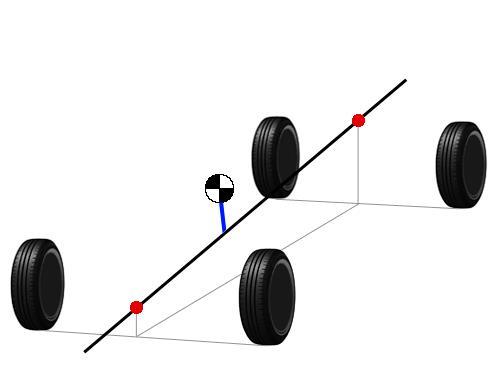
By the way, why do ride height and damping force have anything to do with link angle?
It’s because changing them changes the actual link angle while the car is being driven.
When you change the ride height, the angle of the links changes, so the link angle after the car undergoes a certain amount of body roll also changes compared with before the ride height was changed.
As a result, a difference arises in the front-to-rear distribution of load transfer, and the steering characteristics change.
As for damping force, it changes the speed of body roll and pitching motion, so the transient response changes.
If the damping force is low, the link angle changes more quickly and by a greater amount at an earlier point in time. If the damping force is high, changes in link angle occur more slowly.
For example, that is why running with the rear damping at full soft can make the car oversteer on corner entry.
However, once the roll reaches its peak and the car enters steady-state cornering, the suspension links are no longer moving, so damping force no longer has an effect.
At the same time, damping force also directly plays a role in transmitting load transfer to the tires, so its effects are not limited to this function.
How Roll Center Height Changes the Balance
And finally, let’s look at (5), “The height of the roll center changes the relative influence of each factor.”
This is something that should really be explained using equations, but this time, I’m going to explain it without using any equations at all, with readability in mind.
That means some of the expressions will inevitably be a little vague and therefore somewhat less precise, so please keep that in mind.
If you want to know the specifics, I’d recommend taking a look at the page below. Unfortunately, it’s written in Japanese, and I searched for something similar in English but couldn’t find anything suitable.
I’ll write about it myself someday. Until then, please wait. haha
So, we’ve talked about how the total amount of load transfer for the car as a whole is determined by four factors—vehicle weight, lateral acceleration, center-of-gravity height, and track width—and how the front-to-rear distribution of that load transfer is determined by roll stiffness and link angle.
As a result, if the amount of load transfer at the front increases, the total cornering force from the left and right front tires decreases. Likewise, if the amount of load transfer at the rear increases, the total cornering force from the left and right rear tires decreases.
By the way, the greater the distance between the center of gravity and the roll axis (the roll moment arm), the greater the body roll.
Conversely, as the roll moment arm becomes shorter, body roll becomes smaller. But what would happen if the roll axis and the center of gravity were at exactly the same height—in other words, if the roll moment arm were zero?
In this case, the suspension would not move at all in the roll direction, even when the car was cornering.
However, there would still be load transfer, so the car itself would tilt due to tire deflection.
It would be something like a car whose suspension doesn’t move in roll, or perhaps like a rectangular box with tires attached to it.
(Incidentally, if you raise the roll axis even further from there, the direction of roll reverses.)
So, what happens to the front-to-rear distribution of load transfer in this case?
It becomes the same as the front-to-rear weight distribution at 1 g.
In other words, suppose we have a car with a front-to-rear weight distribution of 60:40. If we raise the roll axis until the roll moment arm becomes zero, the front-to-rear distribution of load transfer during cornering also becomes 60:40.
Now, let’s do the opposite and lower the roll axis.
If we keep lowering the roll axis until it reaches the same height as the ground, the roll moment arm becomes equal to the center-of-gravity height, so the front-to-rear distribution of load transfer becomes the same as the front-to-rear roll stiffness distribution.
At this point, the front-to-rear weight distribution at 1 g no longer matters. So, for example, if we have a car with a 60:40 front-to-rear weight distribution at 1 g and a 50:50 front-to-rear roll stiffness distribution, lowering the roll axis to the same height as the ground makes the front-to-rear distribution of load transfer 50:50.
(Incidentally, if you lower the roll axis even further from there, the direction of the moment transmitted to the body through the suspension links reverses. However, because it is offset by the roll moment reacted by the roll stiffness, the final direction of roll does not change.)
Finally, what happens if the roll axis is at half the height of the center of gravity?
In this case, the car is equally influenced by the front-to-rear weight distribution at 1 g and the front-to-rear roll stiffness distribution.
If you gradually raise the roll axis from there, the influence of the front-to-rear weight distribution at 1 g becomes stronger. If you gradually lower the roll axis, the influence of the front-to-rear roll stiffness distribution becomes stronger.
This time, in order to explain everything using only text and keep the article easy to read, I’ve left out the effects of track width and other factors.
As a basic tendency, I think this explanation is fine, but if you want to do detailed calculations, please be aware that there may be some discrepancies depending on the situation.
If you really want to study this in English, the page below may be helpful. However, it is basically explained on the assumption of a single axle (front or rear), so it differs somewhat from the main point of the discussion here.
“Geometric & Elastic Weight Transfer and the Roll Centre”
So, this time I’ve written about the mechanisms by which changing roll stiffness or ride height changes a car’s steering characteristics.
In a sense, this is load-transfer tuning. There are other ways to tune steering characteristics, such as tire pressure, alignment, and aerodynamics, but the load transfer side of things is one of the most fundamental parts of understanding suspension mechanisms.
I hope you find it useful in some way.