Every now and then, you hear people say something like this:
“That car has a front-downward roll axis, so it has sharp handling.”
It’s true that as the roll axis slopes downward toward the front, a car tends to become more oversteer-oriented. Tilt it the other way, and it tends to become more understeer-oriented.
But why does that happen?
This may be one of the most difficult topics in suspension geometry to fully understand.
In this article, I’ll try to explain it as clearly as possible.
Why Load Transfer Reduces Total Tire Grip
First, take a look at the following graph.
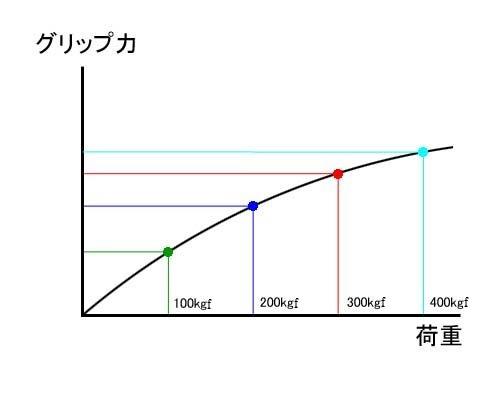
As I’ve explained before, tire grip increases almost proportionally at low loads. However, as the load continues to increase, the rate at which grip increases gradually becomes smaller.
For example, imagine that both tires are initially carrying 2000 N.
Now suppose 1000 N of load is transferred from one tire to the other, so one tire ends up carrying 1000 N while the other carries 3000 N.
Even though the total load remains exactly the same, the combined grip of the two tires actually decreases.
Why?
Because the increase in grip gained by raising the outside tire’s load from 2000 N to 3000 N is smaller than the grip lost by reducing the inside tire’s load from 2000 N to 1000 N.
In other words, reducing load transfer increases the total available grip.
That’s why sports cars are designed with a low center of gravity and a wide track.
So here’s the first key point to remember:
The greater the load transfer, the lower the total tire grip.
Keep that in mind—we’ll come back to it later.
Now, let’s talk about the roll axis.
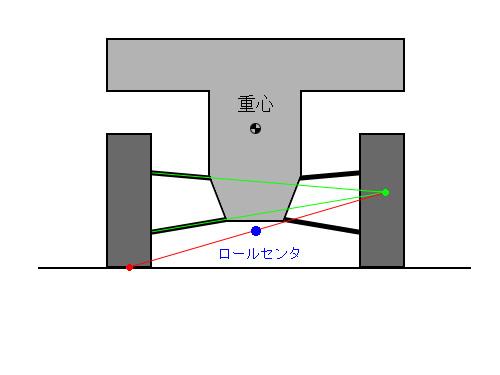
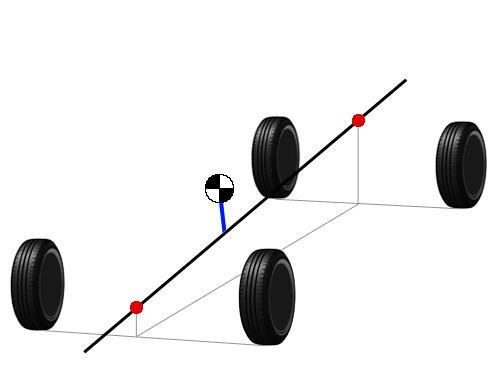
The roll axis is the line connecting the front and rear roll centers.
So, when the roll axis slopes downward toward the front, it simply means that the front roll center is lower than the rear roll center.
For example, if a car suffers from excessive understeer, raising the rear ride height slightly tilts the roll axis further downward toward the front, often making the understeer less severe.
On the other hand, some people leave the ride height alone and instead change the springs or anti-roll bars.
Interestingly, both approaches can alter the car’s steering balance.
Whether you choose to adjust the ride height or the springs depends on many other factors, such as wheel alignment and available suspension travel.
And that’s the key to understanding why a front-downward roll axis tends to make a car more oversteer-oriented.
The important point is this:
Changing either the ride height or the spring characteristics can change the steering balance.
Once you understand why, you’ll understand what the roll axis is really doing.
How the Load Is Shared Between Springs and Suspension Links
Now, let’s look at another diagram.
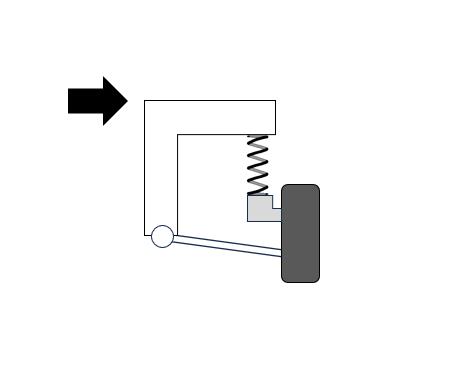
Normally I’d use a double wishbone suspension in my illustrations, but this time I’ve simplified everything by using a MacPherson strut layout.
To make things even easier to understand, we’ll ignore the inside wheel and use a single-wheel model representing only the outside wheel during cornering.
The inside wheel behaves in exactly the opposite way, so you can mentally combine the two later.
Now imagine the car entering a corner and experiencing lateral acceleration.
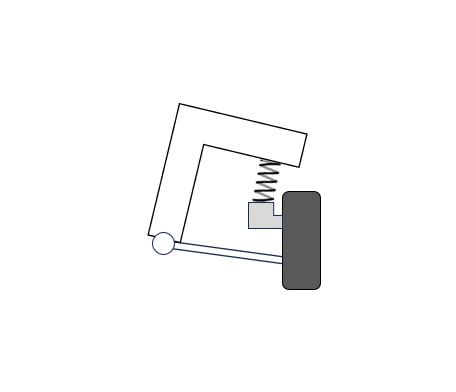
The body rolls like this.
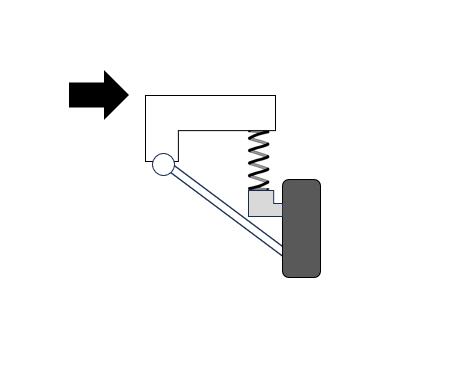
Now suppose we raise only the roll center while leaving the ride height unchanged.
The suspension geometry would now look like this.
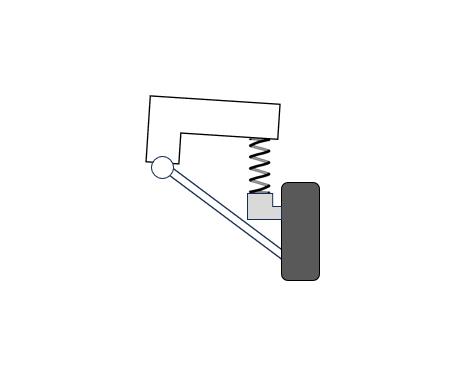
Even though exactly the same lateral force is acting on the car, this suspension rolls much less.
That’s because the suspension arms are now in a position where they can carry more of the load directly.
This is what people mean when they say that the distance between the center of gravity and the roll center is shorter.
It’s also why, in general, raising the roll center reduces body roll.
But wait a minute.
The lateral force—the black arrow shown in the illustration—hasn’t changed at all.
If the force is exactly the same, how can simply changing the arm angle reduce body roll and decrease the load carried by the springs?
Where did that missing load go?
The answer is that it didn’t disappear.
Instead, more of the load is carried directly through the suspension links rather than through the springs.
In other words, the load follows two different paths.
Part of the load is carried by the springs.
The rest is carried directly through the suspension links.
Only the load carried by the springs causes the body to roll.
So the smaller the proportion carried by the springs, the less the body rolls.
As the suspension arms move into a geometry that allows them to carry more of the load directly, a larger portion of the load is carried through the suspension links, while a smaller portion is carried by the springs.
How Roll Axis Setup Changes Handling Balance
Now, let’s go back to what we discussed at the beginning of the article.
Remember that as load transfer increases, the total grip produced by the tires decreases.
That’s why increasing the front spring rate tends to make a car understeer.
As the body rolls in a corner, the stiffer end of the car carries a larger share of the load transfer.
As a result, the front tires lose more of their total grip, making the car understeer.
Exactly the same principle applies to the load carried through the suspension geometry—that is, the load carried through the suspension links as determined by the roll center.
Whichever end of the car has suspension geometry that carries more of the load directly will also carry a larger share of the total load transfer.
If the front suspension carries more of the load directly, a larger share of the load transfer occurs at the front.
If the rear suspension carries more of the load directly, a larger share occurs at the rear.
As the rear axle carries a larger share of the load transfer, the rear tires lose more of their total grip.
The result is a shift in the handling balance toward oversteer.
However, it’s important to remember that the total amount of lateral load transfer is determined solely by four factors:
- Vehicle weight
- Center of gravity height
- Lateral acceleration
- Track width
In other words, whether the load is carried through the springs or directly through the suspension links only changes the load path.
It does not change the total amount of load transfer.
As an extreme example, imagine that the center of gravity and the roll center are at exactly the same height.
In that case, none of the load is carried by the springs.
Instead, all of it is carried directly through the suspension links.
The body would hardly roll at all.
Even so, load transfer would still occur whenever the car corners.
If the car had a high center of gravity, the amount of load transfer would still be large enough that it could even roll over.
That’s one of the reasons why allowing the body to roll to some extent is actually beneficial.
So that’s what roll axis setup is really about.
Or perhaps more accurately…
Roll axis setup is really about controlling how the load is shared between the springs and the suspension links at the front and rear of the car.
How much effect it has depends largely on the vehicle’s front-to-rear weight distribution.
Cars with a weight distribution close to 50:50 are generally much more sensitive to changes in roll axis geometry.
On the other hand, cars with a heavily front- or rear-biased weight distribution tend to be less sensitive.
That’s why FR cars, which often have relatively balanced weight distribution, are commonly fine-tuned for understeer or oversteer by adjusting ride height.
With FF cars, however, that kind of adjustment usually has a much smaller effect.
Changing the front-to-rear damper balance can also influence the steering balance because it changes how the load is shared.
However, dampers behave differently from roll center geometry.
Their effect depends on whether the suspension is in bump or rebound, and it also varies with damper velocity.
So although the underlying idea is similar, the mechanism is quite different.
Suspension design involves many interacting factors, which is what makes it so challenging.
Hopefully, the next time you find yourself wondering, “What does changing the roll axis actually do?” you’ll have a much clearer answer.