Most of you are probably familiar with the friction circle, but a few years ago… I came across an article about it on the internet.
It was written by an individual.
——————————————–
A tire’s grip has a limit.
If you use 100% of the available grip in the longitudinal direction, then you cannot use any of it in the lateral direction.
That is why the car will not turn even if you turn the steering wheel during full braking.
If the tire is using only 50% of its grip in the longitudinal direction, then the remaining 50% can be used in the lateral direction.
If it is using 70% longitudinally, only the remaining 30% can be used laterally.
If it is using 20% longitudinally, then 80% remains for lateral use…
When you actually draw this on a graph… Wait a second.
It does not become a circle.
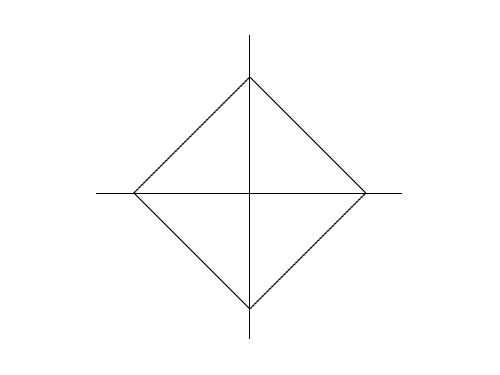
When longitudinal grip is 100%, lateral grip is 0%.
When longitudinal grip is 50%, lateral grip is 50%.
So the commonly used term “friction circle” is actually strange.
The real shape should be a diamond!
——————————————–
That was basically the idea behind the article.
After reading it, some people might think “That makes sense!”, some might think “No, that’s not right,” and some might think “Wait, something feels wrong here…”
But for me, it was a genuinely eye-opening article.
It made me realize that all the explanations about the friction circle that the author had read before were missing something fundamentally important. At the same time, if those explanations were the starting point, then I think it is actually a wonderful thing that someone was able to arrive at this kind of idea through their own thinking.
Let me give the conclusion first. This diamond-shaped graph is created by taking the equation Z = X + Y (where Z ≥ 0, X ≥ 0, Y ≥ 0) and connecting the graphs for the front, rear, left, and right directions.
In this case, Z represents the maximum grip force.
On the other hand, the so-called “friction circle” is a diagram based on the concept of vectors.
A normal mathematical graph and a diagram based on vectors are built on completely different ideas, so it is natural that the shapes are different. But when someone points this out, it is understandable that the two concepts could get mixed up.
To make the difference easier to understand, let me draw a simple diagram.
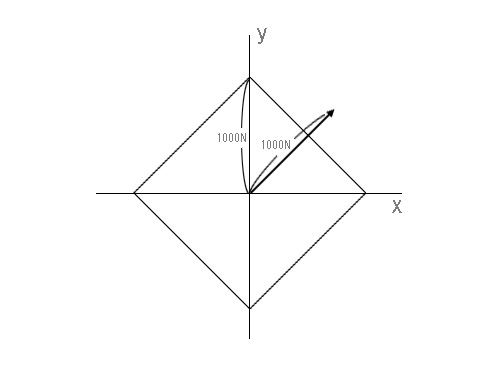
The maximum grip force can be expressed in Newtons, so if we assume Z = 1000N, the equation becomes: 1000N = X + Y.
When this equation is graphed for the front, rear, left, and right grip forces, it does indeed create a diamond shape.
However, when thinking in terms of vectors, that 1000N represents the “length” of an arrow.
If we assume the friction circle is a perfect circle, the idea is that “the tire has the same grip force in every direction across 360 degrees.” Therefore, the magnitude of the grip vector cannot change.
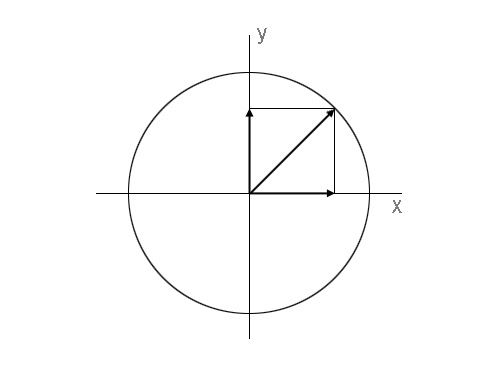
Saying “50% longitudinal grip means 50% lateral grip” is, as a phrase, exactly correct.
However, when thinking in terms of vectors based on the friction circle concept, the vertical or horizontal component at a 45-degree angle is calculated by multiplying 1000N by sin45° (approximately 0.7), so it does not become 500N.
Some people may find this strange, but that is simply how vectors work.
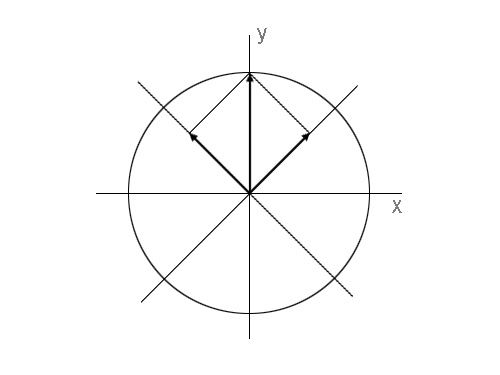
The same applies when splitting the vertical vector component into two diagonal 45-degree directions on the left and right. It does not become 500N.
The same is true for the lateral direction.
When thinking about front/rear and left/right grip forces, I feel that Z = X + Y is slightly inappropriate. However, I also do not think it can simply be called “wrong.”
If someone finds that way of thinking easier to understand, then there is nothing wrong with using it.
That is not the important point. The important point is that the fact that the friction circle is “a diagram based on vectors” was not properly explained.
That is something that needs improvement.
However, if there was no explanation of vectors at all, it would be completely understandable for someone to approach the problem using equations instead.
If that is the case, then naturally someone might look at the friction circle and think, “Something feels wrong here.”
And that “Something feels wrong” feeling is actually very important. It means this person was able to think about the friction circle by themselves.
The result itself is not the important part. The important thing is being able to think independently.
I think that is genuinely impressive!
The friction circle is a circle → Is that really true?
A stiffer spring is better → Is that really true?
A stiff spring is bad → Is that really true?
Canceling toe control makes a car more sporty → Is that really true?
Aki is stylish, handsome, super rich, and flowers literally bloom wherever he walks → Is that really true?
※The last one is obviously a lie. (haha)
I am the same way, but basically, when most people discover something that makes them think “That makes sense!”, they want to tell other people about it.
The internet is full of articles like that.
However, as everyone knows, not everything written there is necessarily correct.
Being able to question what people generally say, verify it in your own way, and then organize your thoughts into your own argument.
In the case of the person who wrote the article about the diamond-shaped graph, they were just one step away. It was a shame, but I think they did a great job.
Simply accepting that the friction circle is a circle without question, versus having the ability to think “Something feels wrong here.”
The difference between the two ways of thinking is pretty clear.
So, that was my story about the friction circle.
Just to be clear, I am not the impressive one here. The person who wrote that article is the impressive one.
The amount of knowledge someone already has does not determine their true ability as a person.
What matters is having the desire to think freely and explore different ideas.