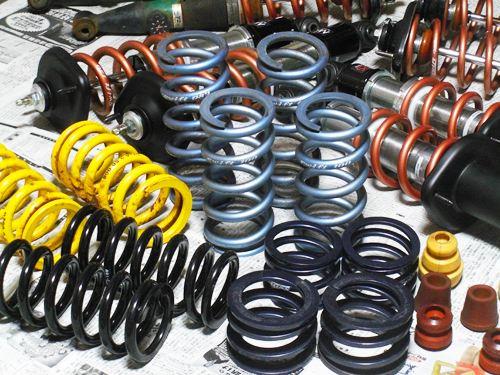
There are many different types of suspension springs, and the shapes of their ends are sometimes described as open-end, closed-end, and so on.
These spring ends are also called inactive coils. In terms of their meaning, they are basically “the part of the spring that is not counted as the active coils.”
In other words, you could say they are “the part that is not used as a spring.”
Since they are not included in the active coil count.
Just a little extra bonus.
By the way, it is said that open-end springs are softer at the beginning of their stroke compared with closed-end springs.
The spring rate of the extra section is lower than the rated spring rate of the product, so until the end coils come into contact with each other, the spring works at a lower rate than its actual specification.
Because of this, you may sometimes hear things like “open-end springs give a better ride” or “the steering response is slower because the initial rate does not appear.”
If someone feels that the ride is better, or that the response feels slower, then that feeling may indeed be correct.
However, there is one important point to be careful about here.
That is:
The “initial” range when talking about the spring itself and the “initial” range when talking about suspension travel refer to different things.
When we talk about the “initial” range of the spring itself, we mean the range starting from a completely unloaded spring, where the load gradually increases from zero.
On the other hand, suspension travel is based on the 1G condition, meaning the state where the vehicle weight is already applied. So in terms of suspension travel, the “initial” range is where the load starts changing from that condition.
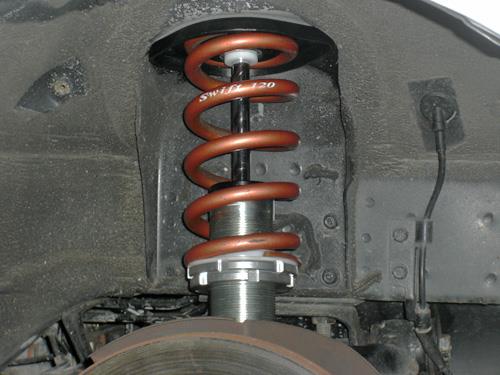
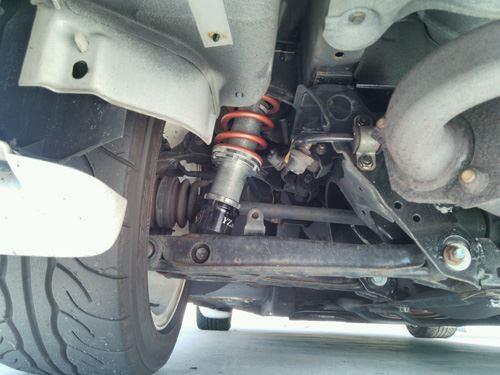
For example, if the load at which the open-end coils come into contact with each other is 500 N, then the range where the softness of an open-end spring can be felt as a characteristic is from 0 to 500 N.
However, when a spring is installed on a vehicle, it already carries the vehicle weight. On the rear of my Roadster, for example, the spring is normally supporting around 3000 N of load.
Of course, while driving, many factors are involved, so the load is not always exactly 1G. But the point is that it is much larger than 0 to 500 N, and that is roughly the kind of range we are talking about.
If you turn the steering wheel from there, the outside spring load increases to 3500 N, 4000 N, and so on, while the inside spring load decreases to 2500 N, 2000 N, and so on.
When you go over a small bump, the load can suddenly reach around 5000 N.
During suspension compression and extension, the load fluctuates above and below around the 3000 N level.
So, what does it actually mean for the load on the spring to drop back down into the range of 0 to around 500 N?
With a high-rate spring, if you hit a large drop in the road surface such as a deep manhole, that one wheel might drop below 500 N.
If you drive a circuit-spec FF car into a corner while braking hard, the rear inside wheel might also drop below 500 N.
If you launch the car over a jump, all four wheels will become 0 N.
In situations like these, the open-end section of the spring actually becomes “open.”
During the instant after that, while the load increases again and the open-end section closes, someone with a sensitive feel for vehicle behavior may be able to notice the characteristics of an open-end spring.
Some people might think, “Wait, that only happens in pretty special situations!”
Others might think, “No, those situations actually happen quite often.”
How you feel about it is up to each person.
The point is that even though we use the same word, “initial,” the actual range it refers to can be different.
Thinking about the specific load values involved in the “initial” range of the spring itself and the “initial” range of suspension travel may help make the concept easier to understand.
Oh, and one more thing: differences between spring brands are still differences between spring brands. Please keep in mind that those factors are outside the scope of this article.