Spring preload is one of those things that is incredibly easy to misunderstand.
And honestly, there are quite a few reasons why people end up thinking about it the wrong way. You can’t really blame them.
After all, the name itself is “preload.”
Ah, well… I mean, what else are people supposed to think? The name is practically setting a trap.
…Does that make sense?
The other day, I was doing some research and came across another article that had the usual misunderstanding about preload.
But the interesting thing was that, on the surface, it was written very logically. Reading through it, I could tell: “This person really put a lot of effort into researching this.”
The article explained that spring rate, strictly speaking, is not always exactly the same from the very beginning to the very end of the stroke.
So even if two springs are rated with the same spring rate, there can be slight differences depending on the manufacturer or design.
For example, open-end and closed-end springs can have different rate characteristics during the initial part of the stroke.
And near the end of the stroke, when the coils are close to becoming fully compressed, the rate can also vary slightly depending on the spring design.
Hmm. Makes sense. Up to this point, everything sounds right.
“So, when you add preload, the spring ends up using more of its stroke, which changes the available stroke range. And that’s why the car’s behavior changes!”
Whoa…
Everything was going so well until that point. How did we end up here?
Actually, I think someone who can write something like this is probably a very smart person.
That’s why I think if you simply step back and think about preload itself, you should notice that something doesn’t quite add up.
The name “preload” is probably causing the confusion.
Let’s think about this carefully. Imagine a spring with a 10N/mm rate that reaches coil bind after 150 mm of travel.
If you apply 50 mm of preload, does that mean the spring will now reach coil bind at 1000 N?
No. To compress a 10 N/mm spring by 150 mm, you still need 1500 N.
It does not become a spring that reaches coil bind at 1000 N just because you added 500 N of preload(which equates to 500 N of force).
Likewise, if you apply 10 mm of preload, does the spring now compress 110 mm? Or if you apply 20 mm, does it compress 120 mm?
That is not how springs work. Try pressing the spring inside a ballpoint pen with your fingers.
No matter how much it was compressed beforehand, the amount it compresses depends on the force currently being applied to it.
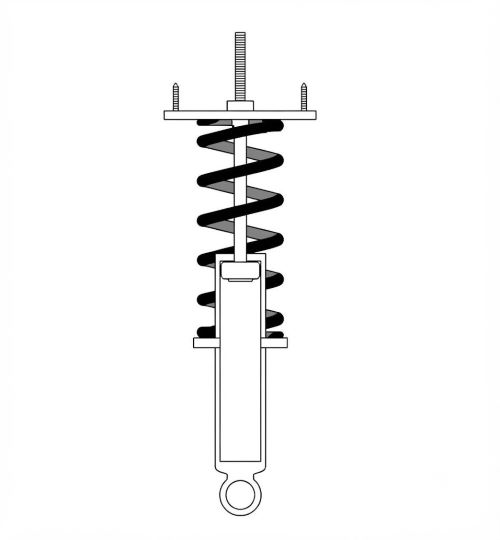
To put it another way, preload is basically this: the damper is preventing the spring from extending.
By making the distance between the damper’s upper mount and lower spring seat shorter than the spring’s free length, the spring is prevented from extending beyond that length.
However, this does not mean that the spring itself is storing some kind of extra force. The damper is simply holding it in place.
For example, if you take a damper with a significant amount of preload and cut the damper rod with an angle grinder, the spring will suddenly extend back to its free length with a loud bang.
Anyone who has ever taken apart an OEM damper can probably picture what I’m talking about.
The damper is the thing holding the spring compressed by the amount of preload.
But what happens if someone with superhuman strength grabs both ends of the damper and forces it shorter by hand?
If the damper is compressed beyond the amount of preload, the rod is no longer carrying that preload force.
At that point, even if you cut the rod with an angle grinder, the spring will not suddenly extend. Because now the spring is being compressed by your hands instead.
Whether the preload is 20 mm or 50 mm, the moment the force from your hands exceeds the preload force, the preload itself has absolutely zero influence on the spring.
When the damper is installed on a car, what compresses the damper is the vehicle weight.
So unless the car is lifted off the ground with a jack, the damper is normally compressed beyond the preload amount.
In that condition, preload has no effect on the spring itself.
But here’s the thing. When you actually adjust preload, something does change, right?
The thing that changes is not the amount of spring travel. What changes is the position relationship between the damper and the vehicle body.
This part is probably difficult to understand through words alone, so let’s look at it visually.
Basically, when people say “adding preload,” what they usually mean is turning the lower spring seat on a damper while the car is lifted with a jack.
A car sitting on a jack stand is a rather special condition—the tires are off the ground and the suspension is fully extended.
But when you are actually driving your car, the tires are not floating in the air, right?
…Wait, are you a WRC driver? My apologies, I didn’t realize I was talking to someone who spends half their time airborne.
(Alright, alright, let’s get back to the topic.)
So, now let’s look at what actually happens when you increase preload while the car is in a normal driving condition—with the full vehicle weight acting on the suspension. Let’s visualize it with an animation.

(For easier understanding, the body is fixed in the air and the ground side is moved instead.)
Now, let’s focus on the damper and look at its internal movement by making it transparent.

Can you tell what is happening here?
Imagine that a camera is fixed inside the wheel housing. You first take a picture with 1 mm of preload added and the car lowered from the jack.
Then you jack the car up again, add another 1 mm of preload, lower it again, and take another picture from the same position.
Repeat this process, and connect ten of those images together to create the animation. That is basically what you are looking at here.
And as you can see, the distance between the upper mount and the damper body becomes longer.
As a result, the position of the piston inside the damper body changes—in other words, the stroke balance changes.
Also, if we look at it from the ground height perspective, the lower spring seat—the platform where the spring sits—moves upward, which raises the vehicle ride height.
And that’s it. Those are the only things that change.
Since all we are doing is moving the damper body position, nothing else changes besides ride height and stroke balance.
The important point here is that turning the lower spring seat does not actually “compress the spring” in the first place.
When the car is lifted with a jack, it may look like that is what is happening, but that’s only because the vehicle weight is not acting on the suspension.
When the car is sitting normally with its full weight on the suspension, increasing preload only changes the ride height and the stroke balance.
But there is one thing that makes this topic confusing. Sometimes people describe a change in stroke balance by saying: “It changes which part of the spring you are using.”
This is not exactly wrong. It is not wrong at all, actually. But it is an expression that can easily create misunderstandings. It’s a bit of a trap.
An engineer from Team Le Mans, a team that has competed successfully in categories such as Super Formula and Super GT, explained preload like this (Reference: Damper Lecture No.101)
———————————–
Does preload affect the mass-spring system?
Changing preload does not change anything about the spring itself, unless the spring reaches full extension or bottoms out, as shown in the diagram. The spring simply oscillates around the point where it balances with the vehicle weight.
The spring does not become stiffer or softer. Only the part of the spring being used changes.
———————————–
See what he says there? “The part of the spring being used changes.”
This seems to be where many people get confused. They interpret it as: “So if I add 10 mm of preload, the spring will compress an extra 10 mm? And if I add 20 mm, it will compress an extra 20 mm?”
But that is not what it means. Interestingly, later in the same article, he explains it like this:
———————————–
Even when the system is excited on a 7-post rig, nothing changes.
Even people from the racing world sometimes come to the 7-post rig and ask: “I was thinking about adding a little preload. What do you think?” And we answer: “You can change it if you want, but unless the spring reaches full extension, nothing will change on the rig.”
Preload is nothing more than a ride height adjustment that changes the stroke distribution. It is nothing else.
———————————–
Exactly. That is the whole point.
By the way, a 7-post rig is a testing machine—a highly advanced road simulator used to reproduce and analyze vehicle behavior under controlled conditions.
Preload is simply a “ride height adjustment that changes stroke distribution.” Nothing more.
Actually, if we want to be extremely precise, preload itself does not necessarily have anything to do with ride height. At its core, preload is simply adjusting the damper stroke balance.
The reason people usually associate preload adjustment with ride height changes is just because turning the lower spring seat is the easiest way to perform the adjustment.
For example, you could remove the damper, take out a 10 mm spacer under the upper mount, and reinstall the damper without changing the height of the lower spring seat. You would have added 10 mm of preload, but the ride height would remain unchanged.
So fundamentally, preload is simply a way of adjusting stroke balance.
In reality, changing stroke balance can affect things like how much the bump rubber is compressed. And if ride height changes, things like toe angle and roll center position will also change.
So it is completely understandable why people think: “Wow, changing preload made such a huge difference! The effect of keeping the spring compressed beforehand must be powerful!”
If ride height changes, of course the car’s behavior can change dramatically. Changing alignment or roll center position naturally affects handling.
But that is not the effect of preload itself. The spring does not behave differently simply because it was compressed beforehand.
If you believe that adding preload makes the spring travel an extra amount equal to the preload, you may run into trouble someday when setting up a car with very limited clearance before coil bind. The actual behavior will not match your expectations.
The true meaning of preload is not really “compressing the spring beforehand.” It is “changing the stroke balance,” or “preventing the spring from extending.” That is what preload does.
But still… the name is “preload.” So honestly, it’s hard to blame people for misunderstanding it.
This is exactly what I meant at the beginning when I said: “…Does that make sense?”
There is nothing we can really do about it, but I have always felt that the name itself is almost like a trap that makes understanding the concept harder than it needs to be.