They say the lower a car’s center of gravity is, the better.
I’d also love it if I could make the center of gravity of my own Roadster a little lower.
Actually achieving that is not easy, because it involves balancing many different factors.
But still, lowering the center of gravity is basically a fundamental principle of sports cars.
Now, our mischievous friend aki decided to challenge this whole idea that “the lower the center of gravity, the better.”
This applies to all kinds of things, but the idea that “more is always better” can be dangerous.
It’s important to look at things from different angles and always ask yourself, “What happens if we take it too far?”
Well…
The manga Initial D says the lower the center of gravity, the better…
And all the experts seem to say the same thing…
Everyone agrees, so surely it has to be true…
…Which is exactly the kind of thinking I’m warning you about!
Alright then.
Let aki, the resident contrarian, prove that it isn’t necessarily true.
A world-first explanation!
Why a lower center of gravity isn’t always better.
Well… probably not actually the world’s first.
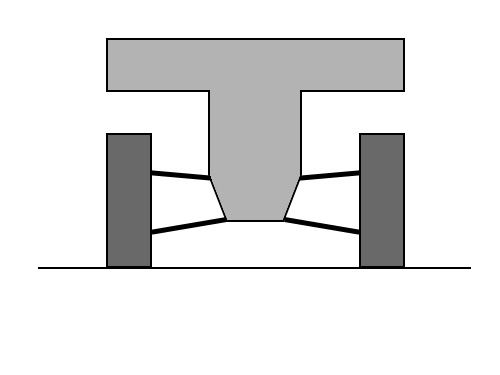
Let’s start with the basic layout.
The tires, the suspension arms, and the body.
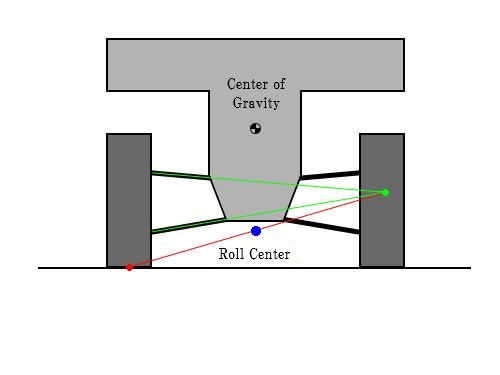
With a double wishbone suspension, the roll center is located like this,
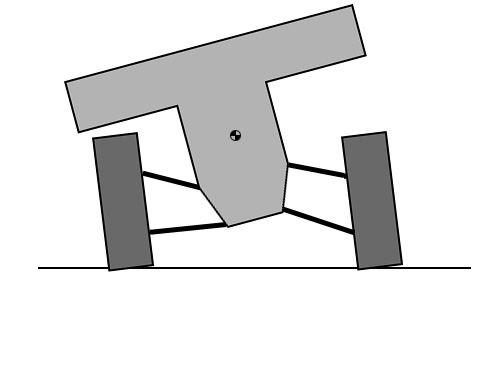
so when lateral G is applied, the body rolls around the roll center.
That’s because load transfer occurs.
And since load transfer reduces the combined grip of all four tires, it’s generally something we’d like to minimize.
The usual explanation goes something like this:
Lowering the center of gravity reduces load transfer.
Therefore, a lower center of gravity is better.
…Sounds convincing, doesn’t it?
But it’s a pretty convenient argument. Almost too convenient.
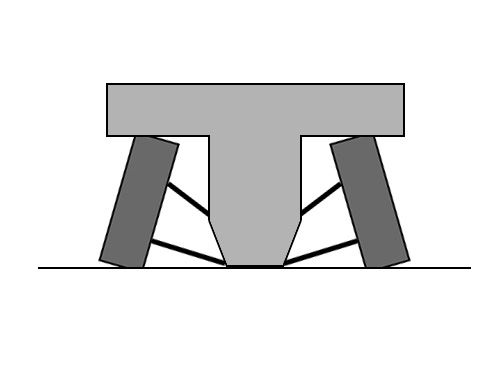
Normally, if you lower the ride height to lower the center of gravity, eventually the body ends up kissing the ground, so you can’t lower it any further.
But actually…
There is another way.
Remember, it’s important to look at things from different angles and think outside the box.
So here’s my solution.
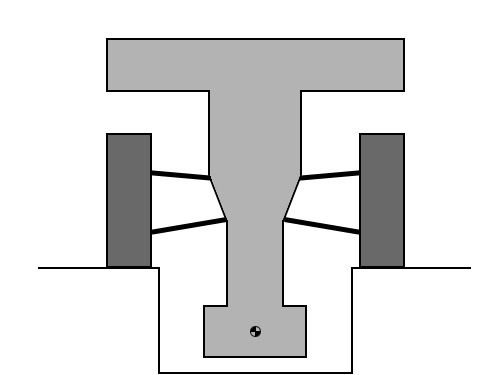
I dug a hole.
I know, I know.
It sounds ridiculous.
But technically, this is a perfectly valid way to lower the center of gravity.
So I haven’t actually said anything wrong.
Just… please don’t throw rocks at me yet.
If we think about it calmly, we’ve attached weights underneath the body, so the center of gravity has moved below ground level.
You might say, “Who would make a car heavier just to lower its center of gravity?”
Hey, don’t blame me.
I only said we should lower the center of gravity.
I never said we had to do it intelligently.
Now let’s assume we really could lower the center of gravity below ground level.
Once you go beyond a certain point, lowering it even further would actually increase load transfer.
So yes.
Lower it too much, and load transfer starts increasing again.
Which means you can’t simply say, “The lower, the better.”
There you have it.
Q.E.D.
Granted, this could never happen in the real world, so the whole proof is completely useless.
Here’s another interesting consequence.
The direction of body roll would reverse.
See what happens?
Turn the steering wheel to the right, and the car leans to the right.
Normally, turning right makes the body lean to the left.
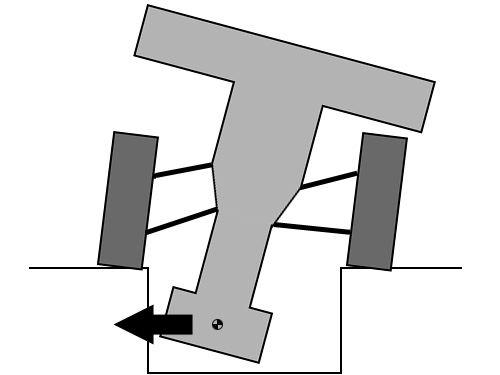
The reason is simple.
The center of gravity is now below the roll center.
A normal car could never be built this way.
But if someone intentionally built a very strange one, it would be possible.
Think about motorcycles.
When they turn right, they lean to the right.
Boats do the same thing.
Airplanes too.
Cars are the odd ones out because they normally lean in the opposite direction from the turn.
Lower the center of gravity below the roll center, and a car would behave more like those vehicles.
I just thought that was kind of interesting.
Honestly…
I went through all of this just to make that one point.
If it made you smile, then I’m happy.
By the way, people often say that if the distance between the center of gravity and the roll center becomes zero, the car won’t roll anymore.
That’s true.
However, unless the center of gravity is also at ground level, load transfer still occurs even if there is no body roll.
A car that doesn’t roll simply behaves like a car with no suspension.
Give it enough lateral G, and it can still roll over even though the body itself isn’t rolling.
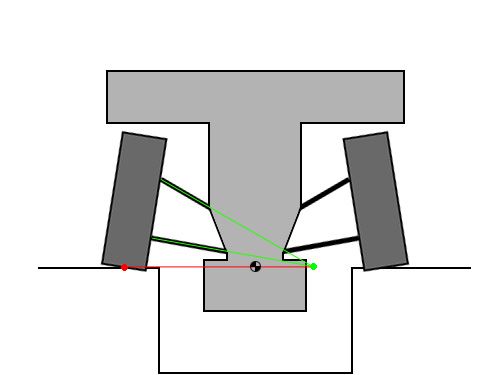
If you somehow built a car where
center of gravity height = roll center height = ground height,
then turning the steering wheel wouldn’t produce any load transfer at all.
In that case, it couldn’t roll over either, because there would be no load transfer.
Of course, such a car can’t exist.
Still…
I can’t help wondering what it would feel like to drive.
Just lower a Roadster, dig a hole, and bolt some weights underneath.
Someone should try it.
(No, not me.)
There really is such a thing as taking free thinking too far.
And that’s why you can’t always say, “The more, the better.”
Or maybe…
this whole article was just an excuse for me to think about something completely ridiculous.