As we discussed in the previous article, this article continues our discussion of response.
Roll stiffness and body stiffness are both important, but tire stiffness is also a key factor.
Have you ever tried attacking a circuit on eco tires or comfort tires?
Compared with tires designed for motorsports, these tires have lower stiffness, and their response is also slower from the moment you turn the steering wheel to the moment the car actually begins to move laterally in response to that input.
And when there is a significant difference in response, it shows up clearly in lap times.
However, when I actually compared a comfort tire with a high-grip tire and measured how the car behaved, I found that even the comfort tire could produce surprisingly high peak longitudinal and lateral G-forces.
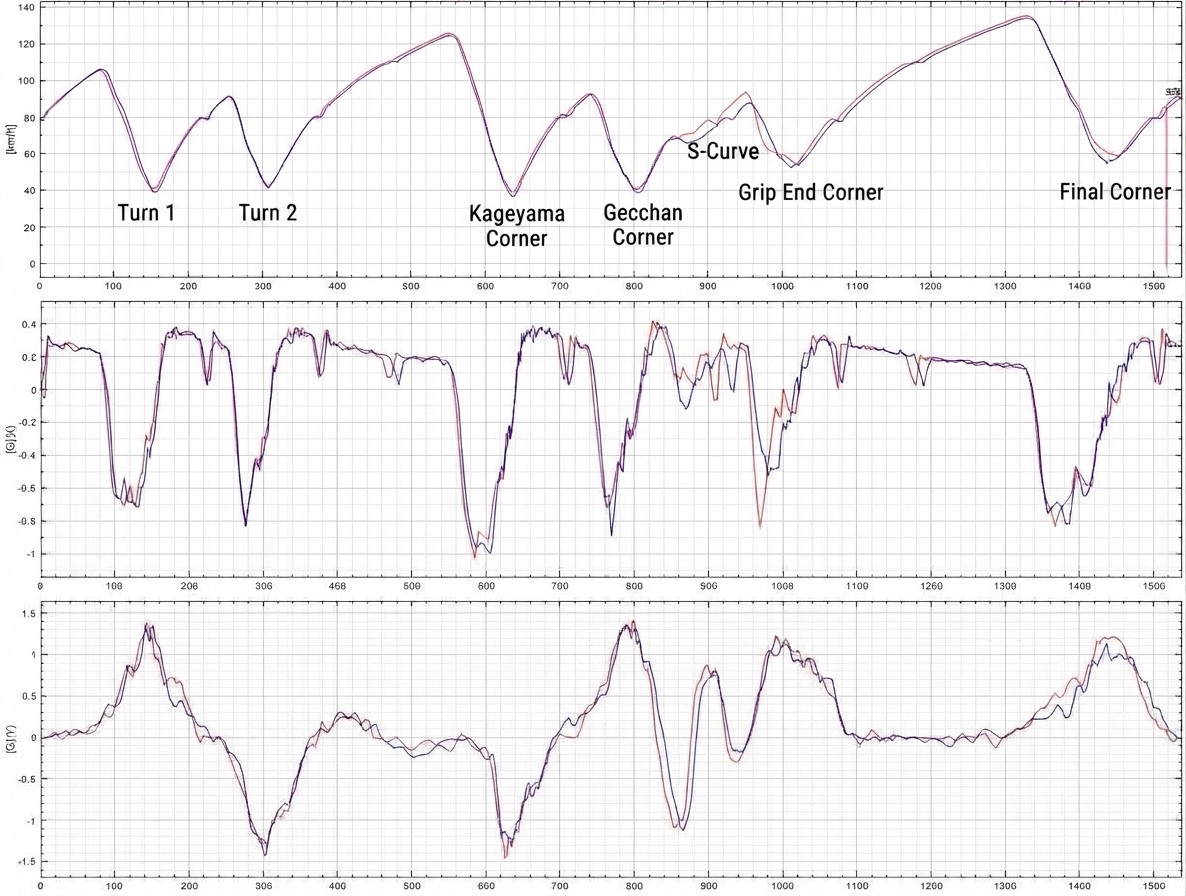
This is a comparison of data from my Roadster: one run on high-grip tires (Dunlop Direzza ZII Star Spec, shown in red) when I set my personal best at TAKASU Circuit, and another attack run on comfort tires (Goodyear Eagle LS EXE, shown in blue).
Looking at the speed graph, you can see a significant difference in the S-curve section, where quick response is especially important.
There are also smaller differences in the first corner, Gecchan Corner, and the final corner, where the corners have a more tucked-in shape, but there is hardly any difference in places such as Turn 2.
The peak longitudinal and lateral G-forces are also almost identical.
In circuit driving, the difference between tire grades can be substantial. Even on a short circuit where a lap takes just over a minute, it is not unusual to see a difference of two or three seconds.
It is generally believed that most of this difference comes from the corners, and I don’t think that is necessarily wrong. However, that does not mean that the longitudinal and lateral G-forces are necessarily lower across the board.
Some of you may be thinking, “Isn’t that just because of the driver, and the difference in the data happened to be caused by a small variation in driving?”
I’m not going to claim that I was driving the car in the theoretically optimal way. However, the red graph from my attack run on the high-grip tires was carefully reviewed by Kishishita, a former professional driver who now serves as the circuit’s dedicated advisor. He told me that even if I could find more time to gain from that lap, it would be no more than about 0.1 seconds.
So I believe you would probably see a similar trend if you tried the same comparison with your own car.
For this comparison, I kept the suspension setup almost unchanged.
The data from this test alone cannot prove that the difference was caused specifically by tire stiffness. However, there was a clear difference in response during the actual driving, and I believe tire stiffness is one of the main factors behind it.
So what difference does that make out on the circuit?
As you can see, there is almost no difference in the peak longitudinal or lateral G-forces.
What changes is whether you can carry the same speed while trying to follow the same driving line.
And the speed graph confirms that this difference becomes particularly significant in the S-curve section, where quick response is especially important.
That’s because an S-curve involves successive changes of direction from left to right, making response particularly important.
Incidentally, the red and blue runs followed almost the same driving line, and because the horizontal axis of the graph represents distance, the points of maximum and minimum speed in each corner line up.
Ultimately, the key point in how a tire’s grip affects the behavior of a car is “when and how much grip the tire generates.”
In other words, differences in tire stiffness do not directly determine the peak G-force. Instead, they indirectly appear as differences in when the tire builds up its grip.
And the effect of this varies depending on the shape of the corner.
A difference can be seen to some extent in corners with a more tucked-in shape, and it becomes more pronounced in an S-curve. However, there are also corners where there is almost no difference.
To put it in extreme terms, if you are simply driving around a constant-radius corner, response has little relevance. Depending on the type of corner, therefore, whether a tire has higher or lower stiffness may have little effect on speed.
Of course, this is not simply a matter of tire stiffness itself, but rather an issue of the vehicle’s overall response. So roll stiffness, body stiffness, tire stiffness, and damping force all play a role.
When it comes to tire stiffness, the stiffness of the tire itself is important, but it also changes with tire pressure.
However, I feel that the fundamental question of how differences in tire stiffness actually affect lap times is rarely discussed. So I wanted to introduce this comparison of driving data to show the differences caused by tire stiffness.
I doubt there are many people who would put comfort tires on a serious track car and go for a full-on attack lap, though…