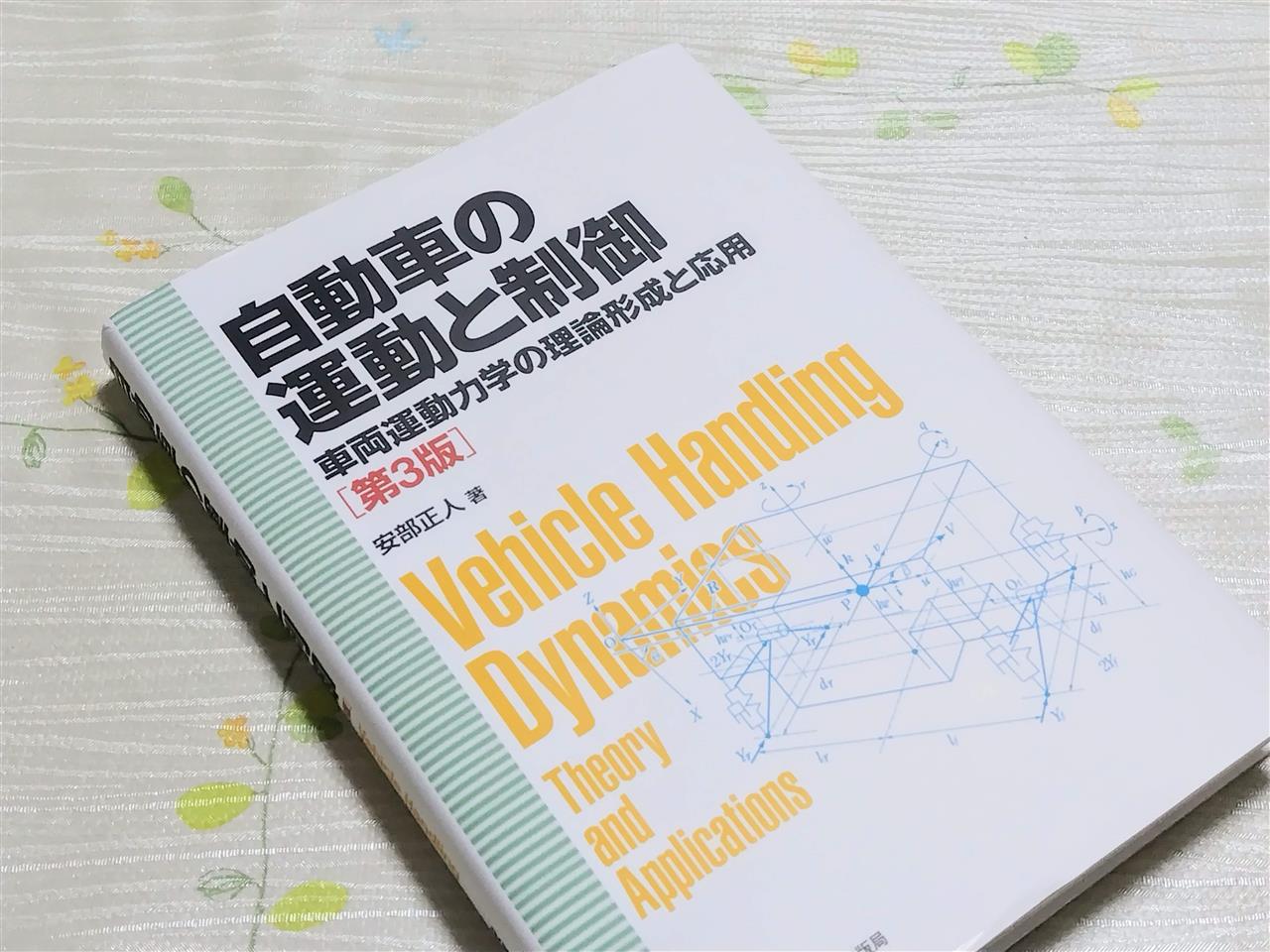
Last year, I bought Masato Abe’s Vehicle Dynamics and Control.
It’s the third edition, published by Tokyo Denki University Press.
I already had the second edition from Sankaido, but I heard that the contents had changed quite a bit in the February 2025 revision, so I wanted to read the new edition and ended up buying a second copy.
Yes. I’m a nerd.
And after reading it, my reaction was basically, “Oh, I get it now!”
I mean, this is really about the roll axis.
Abe must have been pretty serious about this part, because one of the key diagrams is even used on the cover. You can tell he really wanted to make a point.
Here’s an excerpt from the preface.
As was the case in the author’s own previous edition, the term “roll axis” has generally been used in a way that could cause misunderstanding among readers in most textbooks, dictionaries, handbooks, and other references, both in Japan and abroad. Chapter 6 has been revised to correct this. To the author’s knowledge, this is the first attempt in a textbook to present a correct understanding of vehicle roll motion that was pointed out and established some 20 years ago. This is also one of the major reasons for this revision.
Masato Abe’s Vehicle Dynamics and Control has long been well known in Japan, particularly in the fields of vehicle dynamics and suspension design. There is also an English edition, Vehicle Handling Dynamics: Theory and Application, which has been around for quite some time.
The book is full of equations, so for someone with a mathematical allergy like me, it can be a bit intimidating. But really, even the equations are mostly just things like “spring compression is basically load divided by spring rate,” written using symbols. So unless you’re someone like me who gets lost when Laplace transforms and position vectors show up, I don’t think it’s all that difficult.
I usually just skip over the equations anyway.
Anyway, getting back to the part about the roll axis: I’d feel a little bad copying the core material from the latest edition verbatim, so I’ll explain it here in my own words.
So What Is the Roll Axis, Really?
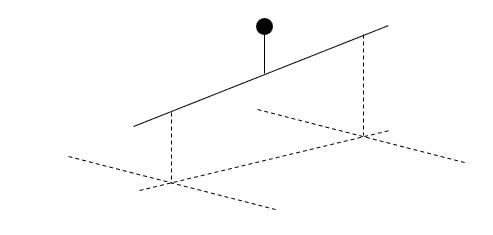
So, the line connecting the front and rear roll centers—the straight line generally referred to as the “roll axis”—is roughly parallel to the ground in the 1G condition. But because the front and rear roll centers are at different heights, it is often not perfectly parallel and has a slight angle to it.
Now, let’s take a car where this line slopes slightly toward the front.
And let’s roll the car.
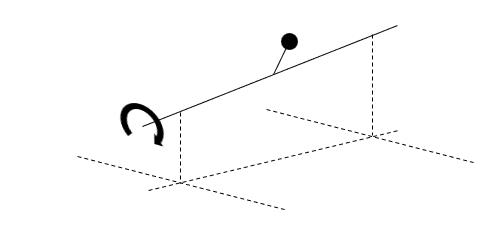
The body would then rotate about this line like this.
And,
“Strictly speaking, that’s not really roll.”
That’s what this article is about.
In short, what we’re looking at here is a combination of roll and yaw. When we consider roll motion alone, things look different. So the point is that it’s important to keep things separate when we think about these things.
So what does that mean?
Roll, Strictly Defined
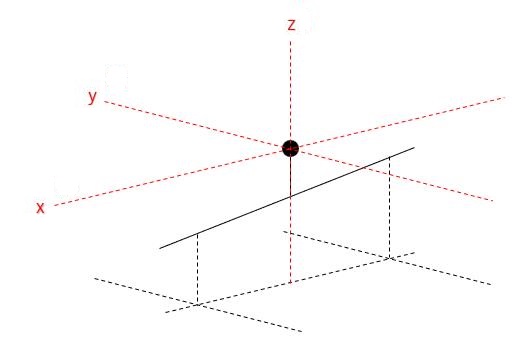
First, let’s define the x-, y-, and z-axes with the center of gravity as the reference point, as shown here.
In vehicle dynamics, rotation about the x-axis is called roll motion, rotation about the y-axis is called pitching motion, and rotation about the z-axis is called yaw motion.
Some of you might think, “But it is rotating about the x-axis, so that’s roll, right?” But according to this definition, roll is only this kind of rotation.
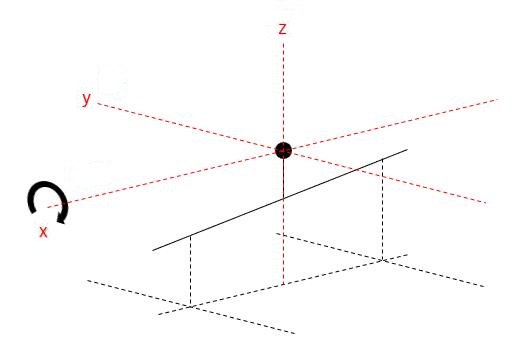
When the axis of rotation is angled, on the other hand, that rotation can be thought of as two separate rotations: one about the x-axis and one about the z-axis.
One about the x-axis and one about the z-axis.
Basically, it’s the same kind of thing as saying, “If you have caster angle, turning the steering wheel gives you camber, right?” You see what I mean?
Where the Yaw Comes From
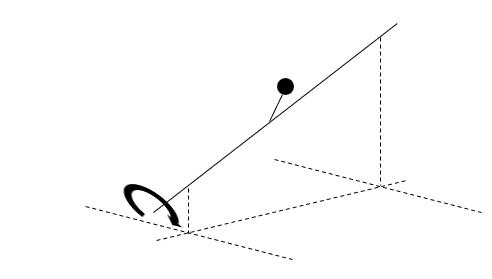
Let’s make the slope more extreme.
If we rotate the car about this axis, the angled axis causes the inside of the car to move slightly rearward and the outside to move slightly forward.
On an actual car, the suspension members pull on the arms, and the arms pull on the tires. So the inside tire is pulled rearward, while the outside tire is pushed forward.
Since the two tires move in opposite directions longitudinally, viewed from above, this produces a yaw rotation. In other words, there’s a yaw component to the motion.
So, as you can see, this isn’t just roll. It’s a combination of roll and yaw.
A Force, Not an Axis
To be a little more precise, the roll center can be thought of as the point where forces from the tires are transmitted to the vehicle body through the suspension arms.
The location of the point of application of the resultant force from the front and rear changes depending on the magnitude of the front and rear cornering forces. In any case, it can be considered to lie somewhere along the line connecting the front and rear roll centers.
If the line is simply there to indicate that “the point of application lies somewhere along this line,” then treating it as though the body were rotating about that axis doesn’t really make sense in the first place. That’s essentially what the book says.
If you want the details, buy the book and read it.
Rethinking Roll Arm Length
By the way, once you define roll motion this way, the definition of roll arm length changes too.
If you define the motion as rotation about an angled axis, the arm length is the shortest distance between that axis and the center of gravity. On the other hand, when we consider roll motion strictly on its own, the roll arm length is the perpendicular distance from the roll axis to the center of gravity.
But in that case, we are deliberately ignoring the yaw rotation, so the yaw component needs to be dealt with separately.
As you can see from the diagrams, in reality the car is not experiencing pure roll rotation alone. So when thinking about what kind of motion actually occurs, what forces that motion produces, and what those forces lead to, I think it’s important not to overlook this.
So, that’s the story of the roll axis.
The point is that if the axis is angled, you can’t simply call rotation about that axis roll. And when you put it that way, I can see how this could easily become a source of confusion. So especially when entering numbers into analysis tools and running case studies, it’s worth being careful, because depending on how things are defined, you might end up working with a value that isn’t actually the one you intended.
To understand something correctly, you first have to see it correctly.
If two things are easy to confuse, keep them separate.