I wrote an article about the definition of the roll axis last time.
We talked about how, strictly speaking, it may not be appropriate to call “the line connecting the front and rear roll centers” a roll axis when that line is inclined relative to the x-axis.
But the angle of the line connecting the front and rear roll centers, as well as its position in the vertical and lateral directions, is not fixed relative to the body.
It is constantly making small movements as the suspension moves while the car is being driven.
This is very important when it comes to understanding how the roll center affects vehicle dynamics, so this time I’m going to look at what factors cause the roll center to move.
As I mentioned in the previous article, calling “the line connecting the front and rear roll centers” a “roll axis” is not necessarily strictly correct. However, since this is already a commonly used term, I’ll deliberately call that line the “roll axis” throughout this article.
One thing to keep in mind is that when the roll axis is not parallel to the x-axis and is inclined relative to it, the body’s rotational motion about that instantaneous axis contains not only a roll component but also a yaw component.
I wish there were a more straightforward name for it. Maybe “the line connecting the front and rear RCs”?
Hmm… that’s not exactly easier to understand either.
How the Roll Axis Tilts Under Braking and Acceleration
Anyway, first, take a look at this animation.

The amount and angle of roll-axis movement vary from car to car, so this animation is only a rough illustration to give you an idea of what’s going on. But the roll axis is thought to move roughly like this.
When the suspension has more travel, the roll axis tends to move more, and when the suspension travel is reduced, the amount of movement tends to decrease as well.
I explain how the roll center is determined in this article, so please refer to that if you want to know more.
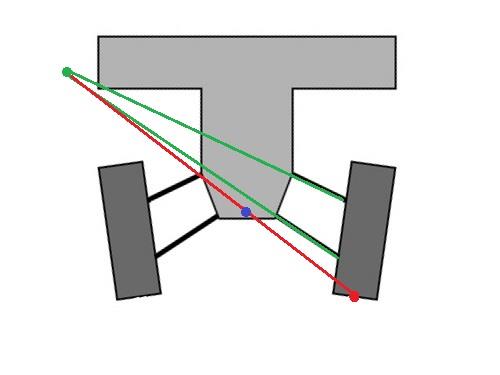
As the suspension moves up and down, the angles of the suspension arms change, which causes the roll center to move vertically like this.
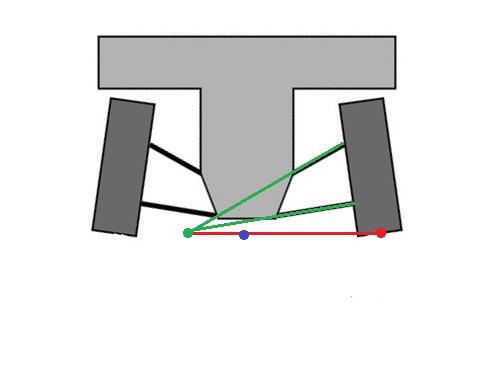
And when the body rolls, it also moves laterally like this.
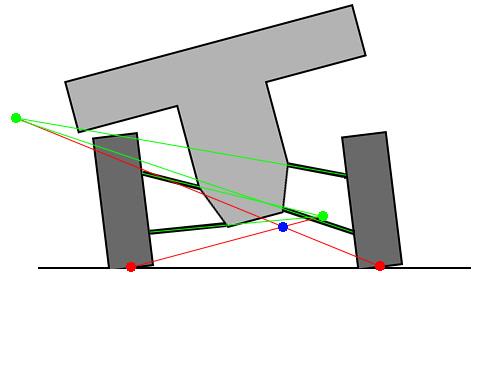
As a result, the roll axis tends to tilt downward toward the front under braking, move toward the inside tire’s contact patch as the body rolls, and then tilt downward toward the rear under acceleration out of a corner.
Normally, longitudinal G is greater under braking than under acceleration, so the change in inclination under braking is greater than it is on corner exit. However, depending on the anti-dive, anti-lift, and anti-squat settings, it is physically possible to reverse that relationship. So, although I don’t know whether there are actually cars that do this, we can’t really say which one is always greater.
Suspension Bottoming Out and Variable-Rate Springs
The roll axis moves in the way shown in the animation as a result of all these vertical and lateral movements, but there are other factors that affect its movement as well.
Some representative examples are suspension bottoming out and variable-rate springs.
For example, if the outside suspension bottoms out while cornering, the outside suspension can no longer compress any further.
The inside suspension, however, is unaffected and can continue extending.
The roll center then moves like this.

Because the outside suspension can no longer compress while the inside suspension continues to extend normally, the roll center moves toward the contact patch of the outside tire.
The same kind of tendency can occur with variable-rate springs or second springs. It is not as pronounced, but depending on the setup, the inside suspension can extend farther than the outside suspension compresses during cornering.
The greater the difference in effective spring rate between the outside and inside, the greater the amount by which the roll center moves toward the contact patch of the outside tire.
Rebound Springs: Pulling the Roll Center Back Inward
Some modern cars also have a rebound spring built into the factory damper. While the rebound spring is active, it makes it harder for the inside suspension to extend.
Therefore, unlike with a variable-rate spring, the roll center moves toward the contact patch of the inside tire.
Even without a rebound spring, the roll center naturally moves toward the contact patch of the inside tire as the car rolls, so the rebound spring simply makes that change larger in the same direction.
Arm Angle Differences and the Jacking Effect
There is another factor as well. As the body continues to roll, the angles between the suspension arms and the ground become different on the inside and outside.
This also changes the amount by which the roll center moves.
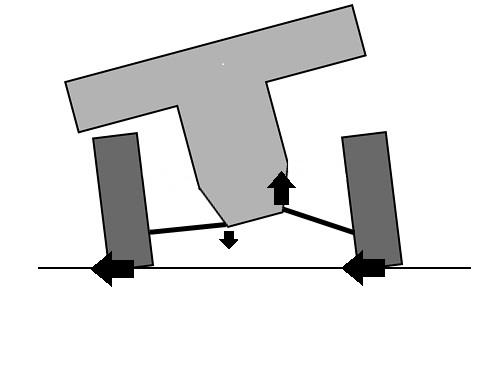
(For simplicity, I’m ignoring the effect of the upper arm here. In reality, it is determined by the angle of the virtual arm—the line connecting the instant center and the center of rotation at the tire contact patch.)
This works on the same principle as anti-dive, anti-lift, and anti-squat: the lateral G generates vertical movement of the suspension arms.
This vertical movement increases as the instantaneous arm angle becomes larger, and is zero when the upper and lower arms are completely horizontal relative to the ground. Since this creates a difference in the amount of movement between the inside and outside, the arm angles change, which in turn changes the roll center as well. In other words, this effect is added to the normal roll-center movement.
Incidentally, if the outside suspension compresses more than the inside suspension extends, the body ends up moving downward as it rolls. This is called “jacking down.”
The opposite results in the body rising, which is called “jacking up.”
Key Takeaways on Roll Axis Movement
So, that’s a look at the various factors involved in the movement of the roll axis.
When the roll axis moves, the distance between the center of gravity and the roll axis changes as well.
And since accurately determining the movement of the roll axis is actually quite difficult, I think it is better to focus on understanding the mechanisms involved rather than trying to calculate it precisely and use the result in actual calculations.
Still, having a general idea of these tendencies can greatly deepen your understanding of suspension behavior, so this is definitely something suspension nerds should keep in mind!