You may have heard the term “short-stroke modification” come up from time to time when people talk about suspension.
It seems to be commonly done to prevent the spring from becoming unseated after lowering the ride height, but what exactly does it involve?
Today, I’m going to show you, with some diagrams, what happens to damper travel when you do a short-stroke modification.
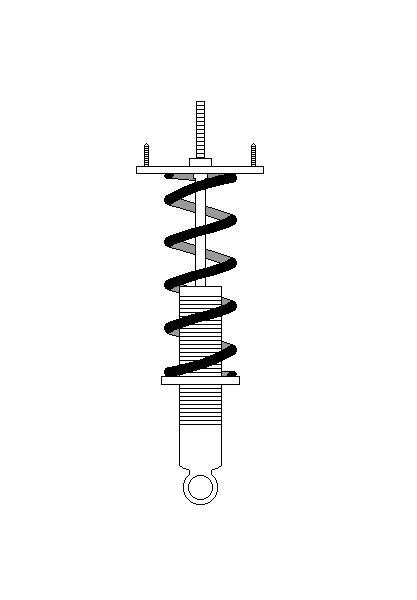
First, here’s an illustration of a damper.
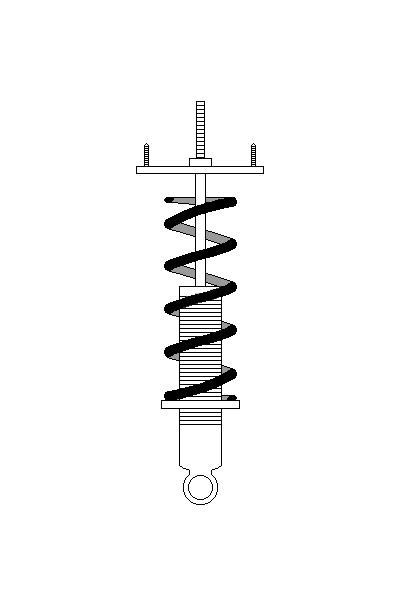
I want to lower the ride height, so I lower the lower spring perch.
And now the spring is no longer captive.
In reality, a little bit of spring movement doesn’t cause much trouble while driving, but the car won’t pass inspection like this.
You could install helper springs, but let’s do a short-stroke modification, just like the title says.
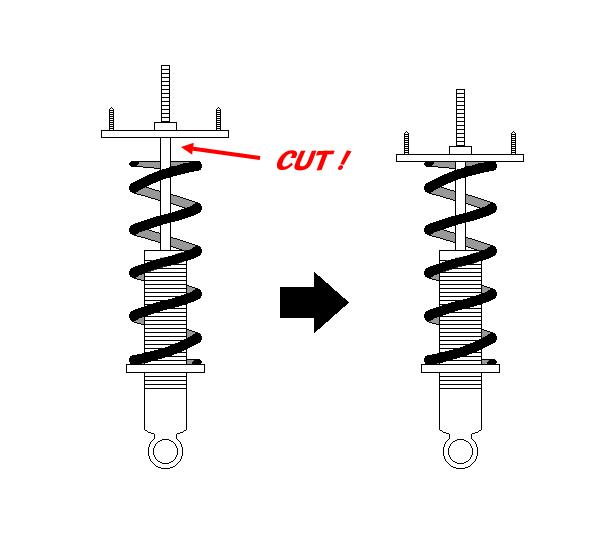
So, I shortened the piston rod.
Now the spring stays captive.
Happy ending.
But wait a minute. Is this really a happy ending?
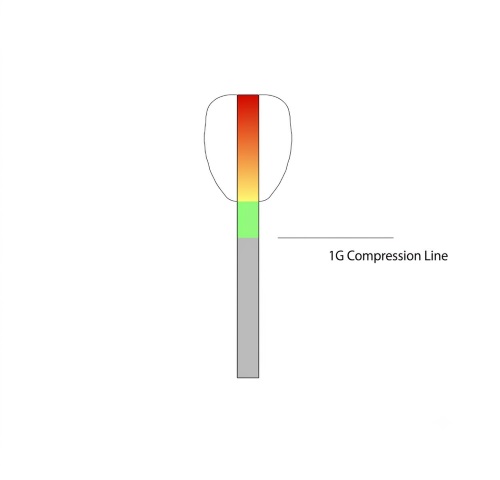
Here’s how the rod travel is divided before shortening the damper.
Gray: Rebound travel
Green: The part of bump travel where the suspension moves at the normal spring rate
Yellow: The part of bump travel where the bump stop is compressing relatively softly
Red: The part of bump travel where the bump stop is compressing more aggressively
For example, let’s say the wheel load is 570 kg, the motion ratio is 1.4, the rod is 80 mm long, and you’re using a 10 kgf/mm spring. At 1G, the damper has compressed by 39.9 mm, or about 40 mm, so you have about 40 mm of rebound travel.
If the rod is 80 mm long and 40 mm of that is rebound travel, does that mean you have the remaining 40 mm as bump travel? Not quite. You need to account for the bump stop, so if the bump stop is 30 mm long, that leaves you with just 10 mm.
You can’t determine the maximum load on the damper during cornering with a simple calculation, but if you only have 10 mm before bump-stop contact, you’re probably going to bottom out on track.
If the damper is already bottoming out, and you shorten the stroke even further, you’ll basically be sitting on the bump stops at 1G.
In other words, you cut away the good, usable part of the travel and end up using only the nasty yellow and red zones.
The suspension can no longer do its job properly, the tires can’t maintain grip, and even small bumps in the road can immediately upset the car. You end up with a car that’s constantly bottoming out and has a very low limit.
For example, if both the damper body and piston rod are unnecessarily long, and you can’t lower the ride height enough because of that, then it may be worth shortening the rod even at the expense of bump travel.
But for cars that are already properly lowered for normal circuit driving or gymkhana, bump travel is often already at a minimum. If you shorten the stroke from there, you simply run out of bump travel and start bottoming out.
You’ll even find articles online saying things like, “Short-stroke modifications make it harder to bottom out even when you lower the ride height,” so be careful.
There is also another type of short-stroke modification where the damper body itself is shortened instead of the rod.
Shortening the damper body allows you to lower the ride height without sacrificing travel, but it doesn’t give you any more room before bottoming out.
The reduced oil volume can hurt durability, and there’s also a risk of the piston crashing into the inside of the damper body at full stroke, so you need to be careful.
And if you shorten the rod to prevent piston crash, you once again make the suspension more prone to bottoming out.
So, the best thing to do is to measure all the dimensions you need before buying coilovers and order a proper setup that won’t require modifications later.
If the coilovers you’ve bought are unavoidably too long, there are shops that can custom-make raised top mounts, so give them the dimensions they need and have them made for you.
When you do this, don’t forget to check the front and rear suspension-arm-to-body contact points and the tire-to-body contact point.
Let’s make cars that can keep their tires firmly planted on the road, even with a low ride height!