One common explanation of the friction circle that you often hear goes something like this:
“The friction circle isn’t a perfect circle, but is closer to an ellipse that is elongated in the vertical direction. In other words, tires can generate more force longitudinally than laterally.”
I don’t even know what my reasoning was, but I used to think the same thing before I started driving on race tracks. The friction circle was elliptical, with a greater length in the longitudinal direction than in the lateral direction. I suspect this is probably a fairly common assumption.
But when I actually started driving on race tracks and looked at the data from my GPS logger, I found that the G-circle was indeed elliptical—but it was actually wider in the lateral direction. I also got to see data from some other fast drivers, and most of theirs looked the same.
So, as I often do, I started wondering about the theory I mentioned at the beginning: “Is that really true?” Because the measured data clearly showed a larger lateral range. I’m the kind of person who has no problem questioning both conventional wisdom and unconventional ideas. Haha.
Eventually, I came to this theory: “I suspect the idea that the longitudinal force is greater than the lateral force probably comes from F1 data. Back in the day, hardly anyone had their own data logger, so people probably read something in a magazine saying, ‘Apparently F1 cars pull this many G under braking and this many G in corners,’ and assumed that ordinary cars must work the same way.”
But even then, something about that explanation didn’t quite sit right with me. It had been bothering me for a long time.
It would be great if tire manufacturers would publish measured data, but I guess that kind of data is treated as confidential, because no matter how much I searched, I couldn’t find any.
But then!
The other day, I suddenly thought, “Maybe there are papers out there with Magic Formula calculations that have been tuned to match measured data?” So I decided to look for some.
(For anyone unfamiliar with it, the Magic Formula refers to a family of equations widely used in tire research. Basically, you plug various parameters into these equations and, even if you don’t fully understand why they work, they empirically do a pretty good job of reproducing actual tire behavior.)
I first tried searching for Japanese papers on Google Scholar, but I couldn’t find anything useful. So I asked ChatGPT to search for papers from overseas as well, and it found a paper on a Formula Student car from the University of Washington.
The paper had exactly the kind of graph I was looking for, showing the maximum longitudinal and lateral tire grip, and I thought, “Whoa!” Unfortunately, when I looked more closely, I was disappointed to find that the data was basically useless, with no scale or units shown on the graph. Maybe the tire manufacturer had asked them not to include any more detailed information.
But when I had ChatGPT keep looking, we found one!
It was a paper from Eindhoven University of Technology, a Dutch university that is highly regarded in Europe for engineering and technology.
Oh yeah, that place! Sure, sure! …Never heard of it.
Extending the Magic Formula and SWIFT tyre models for inflation pressure changes
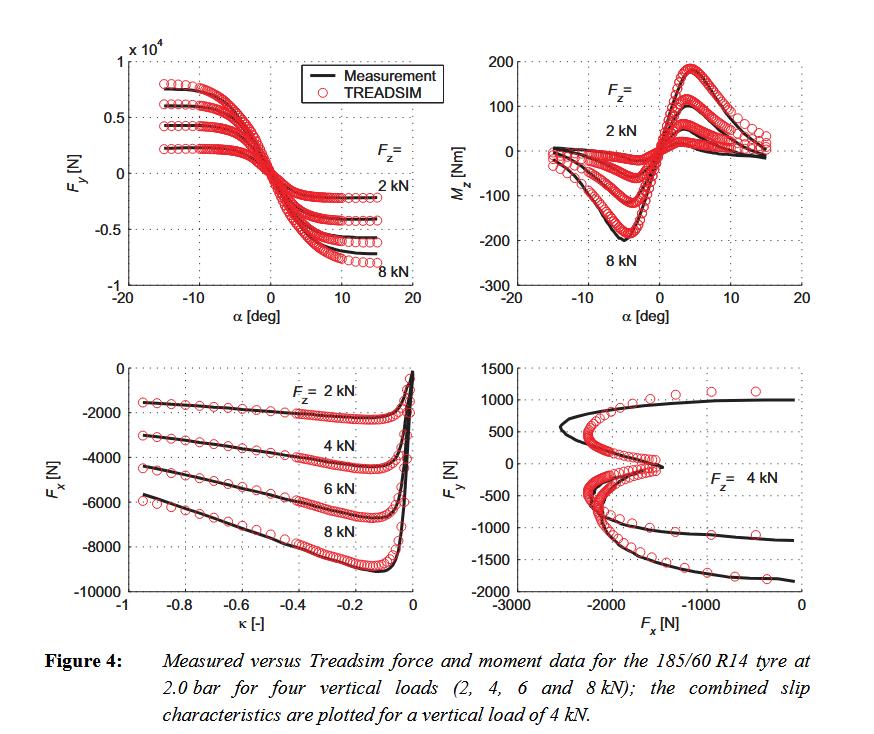
The tire size is 185/60R14.
For some reason, the way the values are presented on the vertical axes isn’t consistent, so the graphs are a little difficult to read. But basically, the graph in the upper left shows lateral tire force versus slip angle, while the one in the lower left shows longitudinal tire force versus slip ratio.
The black lines represent measurements, while the red circles represent simulation results from TREADSIM.
The paper includes graphs for four different vertical loads: 2 kN, 4 kN, 6 kN, and 8 kN. In every case, you can see that the maximum longitudinal force is greater than the maximum lateral force!
Ohhh! So the conventional wisdom was right after all! I’m glad I was finally able to confirm that.
Of course, these are 185/60R14 tires, so things might be different with a more common sports-oriented size, such as 215/45R17.
But when I recorded my track-driving data using 195/55R15 comfort tires, the G-circle was still wider in the lateral direction.
There could be some error in the measured values, but I don’t think the error would be large enough to reverse the relationship between the longitudinal and lateral values. So I still think that, when it comes to vehicle dynamics, the G-circle is wider laterally.
So, why is it that the friction circle of an individual tire is larger in the longitudinal direction, while the G-circle of the vehicle is wider in the lateral direction?
If it is indeed true that an individual tire can generate more force longitudinally, then I think this means that “in real-world driving, we aren’t able to use the full theoretical potential of longitudinal grip.”
Normally, the wheelbase is longer than the track width. So, from the perspective of the load sensitivity of tire grip, if we were able to use the available grip all the way to its limit, the longitudinal value should be greater when measured by a data logger as well, shouldn’t it?
Modern cars use ABS when decelerating and traction control when accelerating, so you might think they should be able to use longitudinal grip at the ideal slip ratio.
But what is actually going on in the control logic?
For starters, the rear brakes are generally designed to be less likely to lock up in order to maintain vehicle stability, so there is probably some loss there to begin with.
Also, even with relatively modern performance ABS systems, I get the feeling that while the actuators and software are very good at controlling the brakes, the control logic might use a value around 1.2 G as one of its thresholds or reference values. That’s just a guess, though.
Unless you’re using something like GPS to obtain position information from outside the vehicle, I think there are inevitably limits to calculating the vehicle’s speed using only wheel-speed sensors and G sensors. (When the tires are slipping, you can’t directly measure the vehicle’s actual speed.)
In other words, due to technical limitations, I suspect the system cannot always maintain the ideal slip ratio during braking.
Incidentally, the slip ratio at which you can generate maximum longitudinal force is different from the slip ratio at which you can generate maximum lateral force, so it’s difficult to compare the two on an equal basis in the first place.
So, my current thinking is this: “An individual tire can indeed generate more force longitudinally than laterally, but in real-world driving, we can’t make full use of that potential. That may be why the G-circle recorded by a data logger ends up being wider in the lateral direction.”
So, today’s story was about how I cleared up one of my own misconceptions. Haha.